


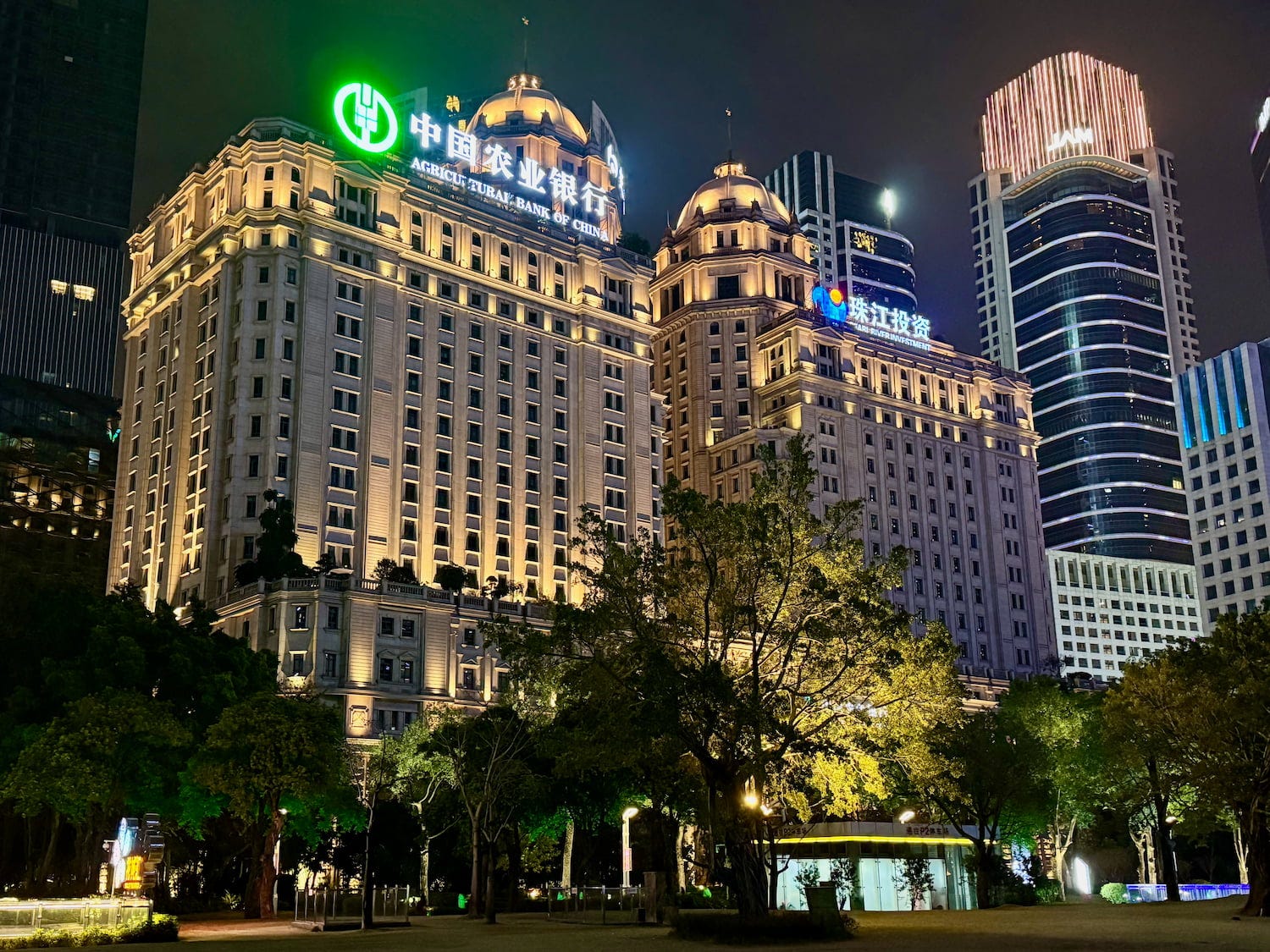
I own four Chinese state banks through their Hong Kong-listed shares. They are paying me 6.8 to 7.4 per cent a year on cost while I wait to find out whether the political settlement on payouts holds — or whether the property book finally forces the kind of write-down nobody can absorb on the cohort’s terms. That is the entire trade. Everything else in this piece is the work I did to convince myself the wait is being paid for.
The positions: Bank of China (BOC), China Construction Bank (CCB), Agricultural Bank of China (ABC), and China Merchants Bank (CMB). Three of these, BOC, CCB and ABC, are part of China’s Big Six: the state-controlled giants that also include the Industrial and Commercial Bank of China (ICBC), Bank of Communications, and Postal Savings Bank. CMB is the largest of the joint-stock commercial banks rather than a Big Six member, included here for its wealth-management franchise. For BOC, CCB and ABC I initially paid trailing price-to-earnings multiples between 3.3 and 4.5 times in 2023 and 2024. The order of size today, largest to smallest, is BOC, CCB, CMB, ABC.
I bought them as bonds.
That sentence is the thesis. Not equities priced for growth. Not deep-value cyclicals waiting on a turn. Four lines of state-bank paper that I underwrote the way you underwrite a long-duration sovereign bond — except the coupon is higher and the duration is longer than anything actually available in the renminbi fixed-income market. The credit risk is absorbed by the sovereign, the currency exposure is to a renminbi I think is structurally undervalued over a ten- to twenty-year horizon, and the equity re-rating is optionality the market refused to price two and a half years ago and is only beginning to price now.
The sell signal is the payout ratio. The hold signal is everything else. A yield that falls from 7 per cent on cost to under 5 per cent at today’s price is not the trade breaking, it is the trade working. The chart below shows how rich that coupon has been: trailing yields on the three state banks peaked in double digits around 2021 to 2022 and have compressed to the mid-to-high single digits as prices re-rated, while CMB ran lower throughout and yields 5.8 per cent at the latest year-end.
The pillar that has to break before the trade does
A payout ratio of 30 per cent of net profit is the policy anchor across the cohort, written into the SASAC framework. Actual payouts have clustered tightly around it: across 2019 to 2025 the four banks paid out between 28 and 36 per cent of earnings every year, never once falling toward the 25 per cent line that would break the frame. CCB declared 30 per cent for 2025, its third straight year at that level, and China Merchants Bank’s articles of association set a constitutional floor of “not less than 30 per cent of the net profit attributable to the ordinary shareholders” — language filed at HKEX in May 2025 and unchanged since. The Big Six aggregate payout for 2025 landed near RMB 427 billion, up 1.6 per cent year on year.
That is not the behaviour of an equity board making annual capital-return decisions. It is the behaviour of an instrument with a payout floor written into the articles of association and into the SASAC framework above them. HSBC has now set 50 per cent as the target basis through 2028 on the 2025 annual filing, which is policy guidance, not a constitutional floor. JPMorgan runs in the 25 to 28 per cent range, conservative by choice. The Chinese cohort pays a smaller share of a larger absolute base, and the base is set by state policy. That is what makes the coupon bond-like. The Western banks pay like equities because that is what they are: boards setting the payout afresh each year.
Two falsifiability lines sit on this signal. A cohort-weighted payout below 27 per cent in any annual print is a yellow flag, a hard re-check on my scenario weights. Any single bank below 25 per cent breaks the frame, and the position comes down. Neither has triggered for 2025.
The Reckoning Point
I underwrite the property book more conservatively than the reported numbers invite. Across the cohort I assume the marks are softer than they look, and a synthetic bond is only ever as good as the balance sheet underwriting the coupon.
What lets me hold anyway is that I never paid for clean marks. I started buying in 2023 at a price that was already discounting a stress scenario worse than the one that has since materialised. Sector-wide property exposure has come down from 13.3 per cent of bank assets in 2021 to 10.4 per cent in 2024, and the system-level non-performing loan ratio sat at 1.51 per cent at the end of 2025. The 2025 prints are not clean. Provision coverage declined at five of the six Big Six banks, and retail credit, mortgages and credit cards especially, deteriorated. None of that surprises me. I bought the cohort with that risk in the price. The question I run on the property book is not whether the marks are accurate. It is whether the marks are improving.
There is a second hard fact, and it is the fairest objection to the whole bond frame. When the state absorbs the credit, it does not write a cheque to the H-share holder. It recapitalises the bank, and a recapitalisation can dilute the very equity it is rescuing. The live version played out in 2025. In June the Ministry of Finance subscribed RMB 520 billion of fresh equity into four of the Big Six, funded by special treasury bonds. Bank of China and China Construction Bank, two of the four lines I own, took part; Agricultural Bank and China Merchants did not. Bank of China sold its new shares to the ministry at RMB 5.93. That was only 0.73 times book, dilutive to per-share value, and at the same time a 7.8 per cent premium to the screen price. The H-share register I sit in, which did not take part, fell from 28.4 to 26.0 per cent of the bank. So the protection I am buying is narrower than the phrase first sounds. The bond frame insures me against the equity being wiped to nothing, which is the outcome the historical record actually rules out. It does not insure me against being diluted on the way through a rescue. Those are two different risks, and I only claim the first.
That changes what I watch, not whether I hold. The event that would make me re-underwrite is the other kind: a placement struck at a steep discount to a price that has already collapsed, the dilutive wipe rather than the supportive top-up. That has not happened to the four lines I own, and it sits beside the payout cut as the thing I watch for.
Four layers, one position
The bond frame has four transmission layers.
Currency. Over a ten- to twenty-year horizon I want exposure to the renminbi, not to companies that happen to be denominated in it. State-bank H-shares are the cleanest large-cap renminbi long I can buy from Hong Kong without taking active corporate risk. The dividends are paid out of mainland net profit in renminbi and converted at the time of payment. If the currency works over the horizon, every other layer benefits.
Multiple. The two charts below tell the rest: the three state banks have re-rated off the 2021 to 2022 bottom and still trade at a fraction of book, CMB richer throughout. Western peers trade at multiples of that, HSBC at roughly 1.6 times tangible book on the 2025 annual filing, JPMorgan above 2 times, DBS at 2.1 times on the SGX filing earlier this year. The gap does not need to close to parity for this to work. Almost any compression at all from where I bought is a structural tailwind on top of the coupon.
The reason the gap can close is that there is a large, structural buyer on the other side of the H-share line. The Insurance Asset Management Association of China reported in early 2026 that 63 per cent of mainland insurers planned to expand their Hong Kong-listed holdings, and of nineteen major insurer share-purchase announcements in 2025, thirteen were in Hong Kong-listed names and seven of those were banks. Two policy facts make the bid durable. The risk capital charge on long-duration equity was cut for insurers in late 2025, and the dividend tax on H-shares sits below the A-share equivalent for mainland holders. The mainland insurance balance sheet needs renminbi duration it cannot find in the onshore bond market at a yield that beats its actuarial assumptions, and the state-bank H-share is where it goes to find it.
Credit. I split the credit question in two: whether the coupon is still being earned, and whether the principal is backstopped. Take the coupon first. The full-year 2025 accounts confirm a net interest margin trough flattening, not a recovery. ABC, charted below, is the clearest read in the cohort: the margin has fallen every year this decade, but the decline has narrowed since 2023, and the rest of the Big Six show the same L-shaped trough. I am not waiting for a recovery before I hold; I hold because the bleed has nearly stopped.
What flattens that trough is the deposit funding cost reset, and it is the most important moving part of the trade. A Chinese family that locked savings into a five-year deposit at 5.3 per cent in 2021 can barely get 2 per cent if they renew today, and the banks are the ones who were paying that 5.3 per cent. As those old high-rate deposits come due through 2026 and roll over at today’s far lower rates, the banks’ single largest cost falls. Loan yields are falling too, under the same rate cuts, so this is not profit dropping straight to the bottom line. It is the force holding the floor under the margin. China International Capital Corporation, relayed by China Daily on 28 February 2026, put the scale of it like this:
According to estimates by China International Capital Corp, roughly 75 trillion yuan ($10.94 trillion) in household time deposits will mature this year, including about 67 trillion yuan with maturities of one year or longer. CICC projects that the volume of total household deposits and time deposits of at least one year scheduled to reach maturity in 2026 will increase 12 per cent and 17 per cent, respectively, from 2025 — equivalent to year-on-year rises of 8 trillion yuan and 10 trillion yuan.
Reprice that mountain at today’s rates and the banks’ funding cost falls by something on the order of a percentage point, on my own estimate rather than anyone else’s. They do not have to do anything clever to capture it; they simply stop paying yesterday’s rates. ICBC’s management described the mechanism plainly in September 2025:
Following the LPR cut we also promptly lowered our posted deposit rates, effectively offsetting the impact on our NIM. Through stringent control of debt costs, we ensured the stability of our net interest margin and net interest income.
The maturity wall is not a forecast. It is already moving through the liability side of the balance sheet, quarter by quarter, and it is what tells me the coupon holds.
Now the principal, and the floor under it is a document from 1999. In April that year the Ministry of Finance set up four asset management companies, one per bank, to take RMB 1.4 trillion of non-performing loans off the Big Four. The Bank for International Settlements, in its third Financial Stability Institute paper on East Asian public asset management companies, put the volume in context:
The four AMCs have been specifically mandated to take over approximately RMB 1.4 trillion (USD 170 billion) in distressed assets from the big four banks, equivalent to around 20 per cent of the combined loans outstanding of the big four banks or 18 per cent of China’s GDP in 1998. This mandated NPL transfer, however, represents less than half of the estimated NPLs of the big four banks.
Eighteen per cent of GDP, less than half of what was actually estimated to be bad, and by December 2002 only RMB 300 billion of the 1.4 trillion had been resolved at an average cash recovery rate of around 22 per cent. The carve-out was the political mechanism that made the IPOs of 2005 to 2006 possible. It also established what the Chinese state does when a Big Six balance sheet is in trouble. I am not arguing the 1999 model recurs identically. I am arguing it is the empirical floor under the sovereign-credit half of the thesis: anyone telling you the Chinese state will let a Big Six bank fail in a way that wipes the equity is telling you a story the historical record does not support.
The live worry on top of that floor is LGFV, the local government financing vehicle: off-balance-sheet companies Chinese cities set up to borrow and build infrastructure, and the banking system funds a large share of what they owe. The IMF’s February 2026 Article IV review put the sensitivity like this:
A 5 per cent default rate among LGFVs would equate to roughly a 75 per cent increase in system-wide non-performing loans, though this exposure is heavily concentrated outside the designated global systemically important banks.
The LGFV problem, an estimated RMB 78 trillion of debt, is concentrated at small regional and city lenders, not at the four banks I own. The Big Six are the system, not the risk inside it.
Optionality. This is where Bank of China earns its place as the largest line. I worked through what the plan means for the wider China book in How I Align My China Portfolio with the 15th Five-Year Plan; the piece relevant here is the financial plumbing. The CPC Central Committee’s October 2025 Recommendations for the 15th Five-Year Plan, the upstream document for the Outline adopted at the NPC in March 2026, set the architecture out directly:
Secure and efficient financial infrastructure should be put in place, and the digital Renminbi (RMB) should be steadily developed.
And on the factor markets above that infrastructure:
To promote the efficient allocation of all types of resources and production factors, we should develop a robust unified market for urban and rural construction land, a fully functional capital market, a free-flowing labor market, and a technology market that facilitates efficient industrial application.
The usual proxy here is the renminbi’s share of SWIFT payments, and it is the wrong one. SWIFT carries the messaging, not the settlement, and a fast-growing share of cross-border renminbi now clears through China’s own system, CIPS, which a SWIFT figure never sees. So I watch the pipe that actually carries the flow. Volume through CIPS reached RMB 175 trillion in 2024, up 43 per cent, and roughly RMB 180 trillion in 2025, more than triple its 2020 level. The renminbi settled close to 54 per cent of China’s own cross-border payments by July 2025, double a decade earlier, and in 2023 passed the euro to become the second-largest trade-finance currency. That build-out of the plumbing, not a messaging-share headline, is the second-derivative move the optionality layer was sized for.
The optionality has a domestic leg too, and it shows up first in the fee line. Net fees and commissions turned positive at all six Big Six banks in 2025, ABC and Postal Savings above 16 per cent growth, and system-wide wealth-management balances reached RMB 33.3 trillion by year-end, up 11 per cent. Some of that is cyclical. Some of it is the franchise CMB has spent a decade building finally compounding, dividend coverage from a line that does not lean on the loan book. CMB sits on the middle-class wealth thread: as the plan lifts household income and deepens the capital markets, the strongest retail franchise earns the fees on that migrating money, the deposit wall showing up as fee income rather than a funding-cost saving. ABC sits on the Three Rurals mandate, the rural and agricultural priority the plan keeps funding, which gives it the clearest claim on state-directed credit growth when the cities are slow.
The optionality I bought for free in 2023 has been formalised into policy language in the 15th Five-Year Plan. That is what has changed in two and a half years. The bond coupon was always there. The map now has names on it.
What I actually own
The 3.3 to 4.5 times earnings I paid in 2023 and 2024 is gone, and even after the re-rating these still change hands near half of book value. But the entry multiple was never the point. What I own is not a cheap equity. It is a callable, very long-duration synthetic bond on the renminbi, with embedded equity optionality the bond market does not offer and the equity market did not price.
The coupon is set by political mandate, the credit is held up by the sovereign, and the price is sitting through the optical noise of a banking-sector P&L for a decade or longer. In exchange I get the only structural way I have found to be long the renminbi at a yield that beats a long-only investor's actuarial assumptions. If the equity never re-rates, the downside case is clipping 6.8 to 7.4 per cent for the duration. For a coupon I bought as a coupon, that is a perfectly good outcome. It is the same income trade I run elsewhere in the book, where I am earning about 6 per cent to own China's AI infrastructure while the optionality matures.
Only one thing actually ends it. It is not the property book, which I bought into the price, and it is not a dilutive recapitalisation, which would make me re-underwrite rather than walk away. It is the payout settlement itself, the day Beijing decides these banks should hold capital back rather than pay it out. That is the one line I cannot hedge, and the August 2026 interims are the next read on it. The coupon holds until the mandate that sets it decides otherwise, and not one day before. Until then I run the book as it sits.
I wrote this from Hong Kong, against the HKEX filings of the four banks on the desk, the State Council’s English-language record of the 15th Five-Year Plan Recommendations, and the Bank for International Settlements paper that sits open behind the position.
As of the date of publication, I hold positions in Bank of China (HKEX: 3988), China Construction Bank (HKEX: 0939), Agricultural Bank of China (HKEX: 1288), China Merchants Bank (HKEX: 3968), and DBS Group (SGX: D05). Positions may change after publication without notice. Cohong Lane is a periodical publication made generally available to the public; this is disclosure of my positions, not a recommendation to buy, sell, or hold any securities. Full disclaimer · About Philip.
Fantastic piece. Viewing this through the lens of a fixed-income trade rather than a deep-value equity cyclical makes total sense of the current yield environment. That RMB 75 trillion maturity wall is a massive structural catalyst on the liability side that almost nobody else is talking about. Thanks for the disciplined framework and the clear falsifiability lines on the payout ratio—clipping a 7% coupon while waiting on the structural RMB thesis is a compelling place to sit.
That makes sense. Anchoring the thesis to a visible payout floor rather than trying to forecast geopolitics keeps it grounded in something measurable. Watching the number, not the headlines, is a disciplined way to run it.