


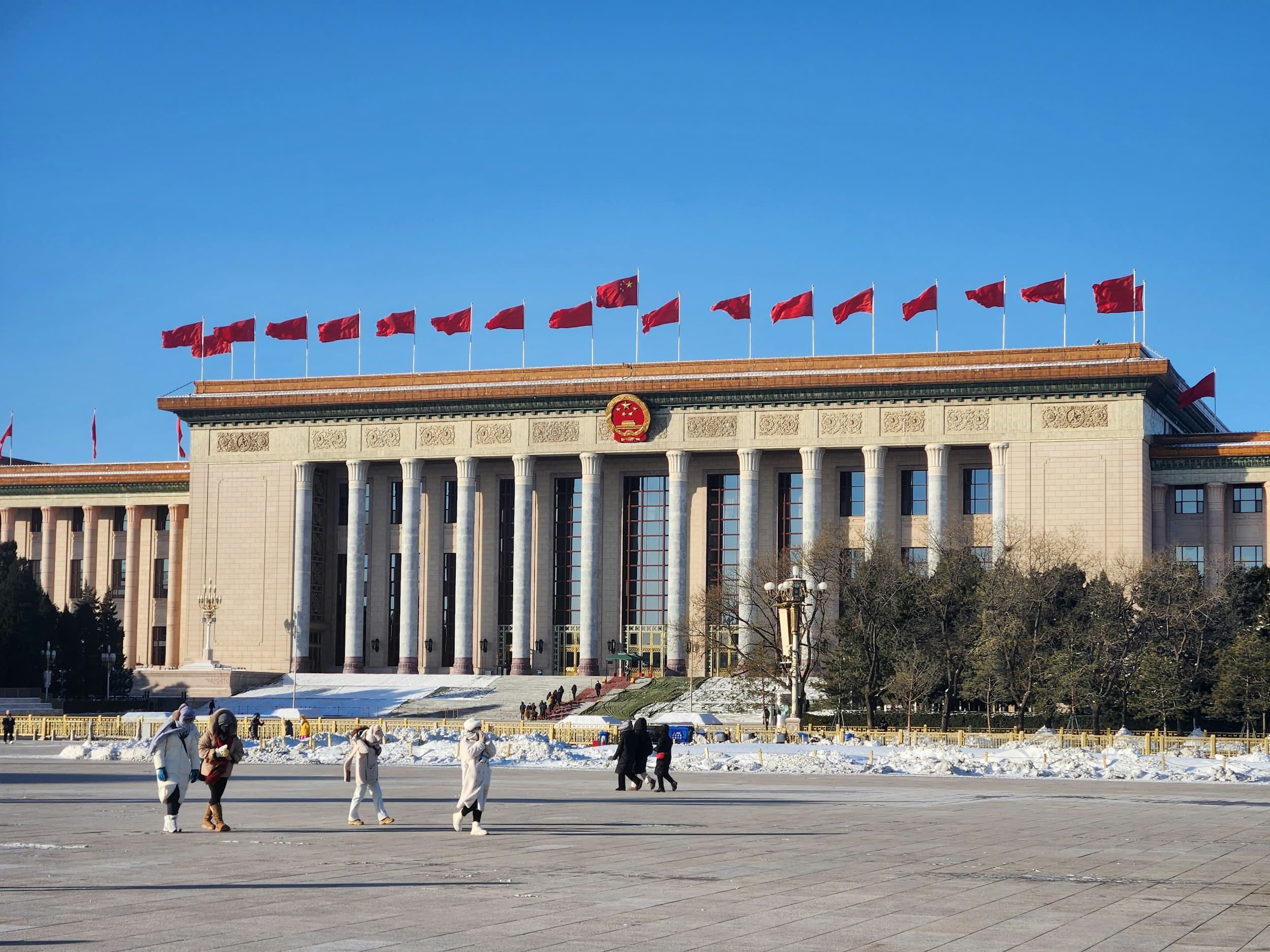
In March 2026, the National People’s Congress (NPC) adopted the Outline of the 15th Five-Year Plan (FYP). The Outline is the screen I will run every name in my China book through for the next five years.
By the time the vote landed, I had been reading its signals for half a year: the Party plenum communiqué in October 2025; the Central Committee’s Recommendations on the 15th FYP in November; MIIT’s AI Plus and Digital Infrastructure action plan in January. The published Outline did not come out of nowhere. It came out of a paper trail that anyone with an indecent quantity of pu-erh tea could read in advance, which is what I did.
The financial press treated the document as a slogan inventory the morning after the vote: AI Plus, Beautiful China, RMB internationalisation, Belt and Road, technological self-reliance. That is not how I read it.
My one-line rule on Chinese equities
I have invested my own money in Chinese equities since 2018. Eight years in, one rule does most of the work: I will not own a Chinese company, public or private, unless I can see how it rides the current Five-Year Plan.
The FYP is not destiny. The 14th FYP correctly called the property deleveraging in writing, and the Hang Seng Mainland Properties Index still fell roughly 75% from its 2021 peak. Plan-right does not equal stock-right. The cautions are part of the rule, not an afterthought, and I will come back to them. The reason the rule still does the work is narrower.
In China, the FYP is the closest thing to an operating manual that the state ever publishes about itself. The chapters tell you what gets funded, what gets licensed, what gets procured, and what the cadres running provincial economies will be evaluated against in five years’ time. If a company I am thinking of owning is not in the chapters, the structural tailwind I am trying to underwrite is not there. If it is in the chapters, I have at least bought myself a fair fight.
The confirmation arrives in chairman letters. I read the FYP first for its house style: the phrases that are too bureaucratic to be accidental, and too specific to be filler. Then I look for the echo. Annual results, capital-markets days, Party committee language, segment descriptions, sometimes a chairman letter doing its best impersonation of a State Council notice. When the same wording appears downstream, I mark it.
The check is that simple. When China Mobile uses the FYP’s exact framing on AI Plus or computing-power networks in its annual results, I am not reading marketing. I am reading translation from state policy to corporate strategy, in print, and free of charge. The phrase is the company telling its regulator, its shareholders, and the cadre evaluating its Party committee that it has read the manual and is acting on it. That tell carries more signal than almost anything else an outside investor gets in this market.
Why these things bind, and when they don’t
Five-year plans bind, when they bind, because the people executing them get graded on them. The 2019 Regulations on the Evaluation of the Work of Party and Government Leading Cadres are still in force. The mechanics are unromantic. A Party committee evaluates a cadre once a year and at the end of each term. Indicators include implementation of Central decisions and “high-quality development” outcomes, which is the technical phrase for “the things written in the FYP.” A “basic competence” rating triggers a formal admonishment and a deadline to improve. A “poor” rating costs the cadre a rank. Sustained underperformance can cost the principal responsible person the job. That is why the manifesto is a manual. “The state has decided X” in China is not a Western press statement; it is a behavioural instruction tied to a cadre’s evaluation, promotion prospects, and, eventually, job security.
The Outline itself tags only some indicators as binding and most as expectative. That is the system telling you which lines a cadre will actually be punished against.
The mechanism is real but uneven. Provincial governments game the binding numbers, particularly the environmental ones. Cadre rotation can break term-end accountability before it tightens. Chapters the Party prefers not to enforce get under-resourced rather than rejected. The screen relies on it where it bites.
The horizon is the other thing that makes the FYP serious. The 15th nests inside the 2035 long-range objectives, which were adopted with the 14th FYP in 2021 and which speak in the directional language of “by 2035, China will basically achieve socialist modernization.” Two five-year plans, one strategic horizon. The 16th FYP will be the third leg.
I run my own portfolio with an Income and Growth structure and a five-year minimum horizon on positions, and the FYP-2035 stack tells me the policy direction I am underwriting will not be unpicked at the next reshuffle.
Roughly twenty-five things in the 15th FYP would interest an investor. Four have already changed something on my screen. Here they are, in the order they hit my book.
New productive forces, AI Plus, and a computing build that someone has to actually pay for
The 15th FYP carries one phrase that does more work than any other for an investor: “new productive forces”. This is Beijing’s official language for the strategic shift out of the concrete-and-rebar growth model and into technology-led productivity, advanced manufacturing, and the AI-enabled industrial stack. The state has decided to spend the next five years levelling its economy up the value chain rather than rebuilding the apartment blocks.
AI Plus is the most concrete instruction inside it. The Outline’s Chapters 11 and 14 direct the “full implementation of the AI Plus initiative” and the construction of “a nationally integrated computing power network”. The same chapters state explicitly, in the official English translation, that the state will “support meeting compute demand through multiple mechanisms including government procurement of compute services and compute leasing”. That is industrial policy as a purchase order.
Between an FYP chapter and a corporate result sits the State Council’s implementing notice. In March 2026, the State Council instructed ministries to issue sector plans against the Outline and provincial governments to issue local execution plans. Sector plans become provincial budgets, become procurement, become next year’s loan book at ICBC, become, eventually, the line in China Mobile’s results that says “computing services revenue +11.1%.” I cannot watch every step of the cascade. I can watch the company at the bottom.
The transmission line into my book is China Mobile, the largest of the three Mainland state-owned-enterprise (SOE) telcos and the cleanest example I have of how this works. (For the avoidance of doubt: I own all three; China Mobile is the primary AI Plus position, with China Telecom and China Unicom smaller weights for the same reason.) China Mobile spent RMB 150.9 billion on capex in 2025. It built up to 92.5 EFLOPS of intelligent computing capacity at FP16 (the standard half-precision benchmark for AI compute) and more than 1.5 million standard racks. Computing services revenue grew 11.1% to RMB 89.8 billion. AI services revenue grew 5.3% to RMB 90.8 billion. None of that says “AI Plus mandate” on the income statement; the Chinese state does not insist companies file in the language of state planning. It shows up in the next year’s results as bigger numbers in the sub-segment that does the work.
The cross-check sits next door. China Telecom last year reported industrial digitalisation revenue of RMB 147.3 billion, group capex of RMB 80.4 billion, and 91 EFLOPS of intelligent computing capacity. China Unicom’s 2025 results show the same shape at smaller scale. Three SOEs, comparable direction, comparable cadence. The AI Plus build is industry-wide and Plan-driven, not idiosyncratic to any one name. When I see three SOEs doing the same thing at the same time, I assume someone at the State Council told all three of them to do it. That assumption is rarely wrong.
The demand side is where my auto and sensor exposure earns its place. I covered the supply side in 50,000 Factories: What China’s AI Mandate Means for My Portfolio when MIIT’s January action plan landed. The demand side is the same wave hitting different income statements. BYD shipped over 4.6 million New Energy Vehicles (NEVs) in 2025. Geely crossed CNY 345.2 billion in revenue. Hesai tripled its LiDAR shipments year-on-year on RMB 3 billion of revenue. Those companies do not sell to “new productive forces” as a line item. They sell into the demand wave the FYP frames at the chapter level. That is the difference between a slogan and a screen.
The Beautiful China indicators and a power generator nobody talks about
The Outline carries a table called Box 1. It lists the Plan’s quantitative majors over the next five years and tags each one as binding or expectative. The bound ones are the numbers a provincial cadre will be measured against at term end. The expectative ones are directional aspirations the system will work towards but will not punish on. The ecological cluster is the bit I take most seriously, and the targets are explicit, sourced, and date-stamped: PM2.5 below 27 micrograms per cubic metre by 2030, and non-fossil energy at 25% of primary energy consumption by 2030. For a utility, that is not mood music. It is the policy mechanism above the income statement: permits, dispatch priority, grid connection, local approvals, and the career incentives of the officials who sign them. The longer-horizon directional commitments, peak carbon before 2030 and carbon neutrality by 2060, sit in the 2035 Long-Range Objectives, which is a different document.
If you have not heard of Beijing Jingneng Clean Energy, that is fine. It does not market itself outside Hong Kong investor presentations and does not need to. It is a piece of Beijing’s municipal-SOE clean-power plumbing that happens to be listed. At end-2025 it held 18,365 megawatts of consolidated installed capacity. Renewables were more than 72% of it. It generated 42.45 billion kilowatt-hours over the year. The chapter says the share of non-fossil in primary energy has to reach 25% nationally. Beijing Jingneng moves the share inside its own book in the same direction, faster, and files its disclosures into HKEX where I can read them. The Plan does not need to name Beijing Jingneng; the filing already shows me which way the municipal-SOE plumbing is being pushed.
People-centred urbanisation and the household balance sheet
The Outline’s Chapter 31 is titled “In-Depth Advancement of People-Centred New Urbanisation.” It is one of the more consequential chapters and one of the easier to misread. People-centred urbanisation is not a return to the property boom. It is the explicit policy frame for moving people from villages into county towns, from county towns into mid-tier cities, with formal hukou (the household-registration system that gates access to schools, healthcare, and other public services in a given city) access, formal credit access, and formal social services. It is the chapter that tells you the next five years of Chinese domestic demand are going to come from a different pool of households than the last five. Four names in my book sit on this line.
China State Construction International (CSCI) is the build-side read. Its order book is heavily Modular Integrated Construction (MiC) work, the urban-renewal modality the Outline names directly. MiC is factory-built construction: more industrial process than old property cycle, more repeatable production line than apartment-boom labour stack. That is the version of construction I want exposure to if the post-property build still has to happen.
The banking read starts lower down the household ladder. Agricultural Bank of China (ABC) has the largest county-level branch network of any Chinese bank, founded on the “Three Rurals” mandate (agriculture, rural areas, rural households), already on file with the village and county households the Outline says will be moving up the urbanisation ladder over the next five years. The county economy is where hukou reform, infrastructure spending, and township-enterprise upgrades land first; ABC banks that economy as a matter of original mandate. The hukou line matters because it is where a migrant household starts becoming bankable as an urban household, not just visible in a migration table.
China Merchants Bank (CMB) sits at the other end of the same household migration. It is the leading retail and wealth-management franchise in Mainland China by client assets under management and by private-banking penetration, structured to capture the wealth-management fees, retail credit spread, and asset-management margin as the middle and upper-middle class that the Outline’s domestic-demand chapters describe continues to grow. The Plan does not have to mention either bank for the screen to matter. It describes the household whose financial life each of them is already structured to serve.
Ping An is the overlap case. One leg is the ageing chapter (Chapter 40), where its life and health insurance franchises sit directly on the structural tailwind: 7.6% operating profit growth in 2025 and resilient new business value in life are what the demographic line is supposed to look like inside an income statement, long before it shows up in the obituary pages. The other leg is the wealthier-household thread that lifts CMB: insurance, retirement, and life-stage savings products for a richer customer. One leg would not earn the size; two legs do.
None of these four is a breakout bet. All four are FYP-aligned. The urbanisation chapter does not promise any of them a return. It tells me they are running into a policy wind the state has decided to keep blowing for the next five years.
RMB internationalisation, the Belt and Road, and the part where boring banks earn their keep
Part Seven is mostly about external opening. Chapter 21 on autonomous opening-up. Chapter 23 on the high-quality co-building of the Belt and Road. Chapter 24 on the shared-future framework. This is the chapter cluster that sounds the most like a slogan inventory and the least like a procurement order, which is precisely why most foreign investors give it the lightest reading and miss what it does in practice.
I own Bank of China (BoC) for it. BoC’s 2025 results show continued growth in cross-border RMB settlement and a higher share of operating income from overseas, which is the literal income-statement signature of Chapter 21. I also own China Merchants Port (CMP). Port assets along the Belt and Road Initiative (BRI) corridors are the listed surface of Chapter 23, and CMP’s 2025 overseas terminal throughput and core-port profitability are what a multi-year corridor build is supposed to put on an income statement. Neither name will ever be a multi-bagger. Both have already done what they are meant to do, which is keep delivering operating cashflow while a chapter of the FYP says, on government letterhead, that what they do is to be encouraged. Names such as these fit my Income book.
If "RMB settlement bank with HK depth" and "overseas port operator with corridor exposure" are not the most exciting sentences in this article, that is the point. That is the job I want them to do in the Income book. The AI line can carry the excitement; these names have to carry cash.
Where the FYP got it right and the stocks still lost money
The FYP being decision-useful is not the same as the FYP being a return engine. Two cautions.
Plan-right does not equal stock-right at the sector level. The 14th FYP correctly diagnosed that the property cycle had to deleverage. It said so in writing, and the system acted on it. The Hang Seng Mainland Properties Index then fell from a peak near 4,000 in early 2021 to below 1,000 by 2024. The macro thesis was right. The equity outcome was a 75% drawdown. If you had bought sector exposure on the official narrative alone, you would have lost three quarters of your money being correct. FYP-aligned is the screen. It is not the position.
Geopolitics overrides the FYP at the firm level. The US Department of Commerce added Yangtze Memory Technologies Co. (YMTC, China’s leading memory-chip maker and a 14th FYP self-reliance flagship) to its Entity List in December 2022, and tooling-export controls have continued through 2024. No FYP can write its way around an export-control regime in another sovereign’s jurisdiction. If you cannot live with that risk, do not own these companies. I can, but I size these exposures as options on the self-reliance thesis, not core income positions.
I write my one-line rule with these caveats inside it, not after it. The rule is “FYP-aligned and worth what I am paying,” not “FYP-aligned.” The first half gets the company on the screen. The second half is the rest of the work, industry by industry, company by company.
The screen at work, and the test that comes next
The 15th FYP matters to me only if it moves from language into behaviour, which is the test.
The names in this article are not a recommendation list. They are the screen at work. The screen keeps me out of the wrong fights. It does not win the right ones for me. My actual book is several dozen Mainland and Hong Kong listings deep, and the screen runs across all of them, every quarter, against every important disclosure HKEX puts out. Names that do not sit in the chapters do not make the book, even when they screen cheap on backward-looking metrics. Names that do sit in the chapters still have to show me the translation: procurement, licensing, capex, loan growth, segment revenue, margin quality. Otherwise I have only found a slogan with a ticker attached.
The first real test of the screen lands over late 2026 and 2027, when State Council sector plans and provincial execution plans start translating Outline language into procurement, licensing, and capital allocation. After that come the corporate echoes: SOE annual results, segment disclosures, loan books, chairman letters, and the awkward phrases that have clearly travelled from the Plan into the company.
That is what I will be reading for over the next five years: not whether the slogans repeat, but whether the wording migrates into sector plans, procurement lines, loan books and SOE chairman letters. If it does, the manual is moving from paper into P&L. If it does not, the screen gets marked down.
As of the date of publication, I hold positions in Agricultural Bank of China (HKEX: 1288), Bank of China (HKEX: 3988), Beijing Jingneng Clean Energy (HKEX: 579), BYD Company (HKEX: 1211), China Merchants Bank (HKEX: 3968), China Merchants Port (HKEX: 144), China Mobile (HKEX: 941), China State Construction International (HKEX: 3311), China Telecom (HKEX: 728), China Unicom (HKEX: 762), Geely Automobile Holdings (HKEX: 175), Hesai Group (NASDAQ: HSAI), and Ping An Insurance Group (HKEX: 2318). Positions may change after publication without notice. Cohong Lane is a periodical publication made generally available to the public; this is disclosure of my positions, not a recommendation to buy, sell, or hold any securities. Full disclaimer · About Philip.
I would add BABA to your list. I would think the 15-year plan would overlap with AI infrastructure buildout and helping their 1.4B population shop e-commerce wise everyday. BABA is the commerce and consumer infrastructure of China.
Hi Sir,
Would you mind to share you opinion on how the Chinese E-Commerce Platforms ride the current 15th Five-Year Plan of China?