


The clause everyone skipped on the way to the headline
China’s draft mandatory standard for automated driving systems requires fault-tolerant perception, not a specific sensor, and that distinction changes how the rule hits my portfolio.
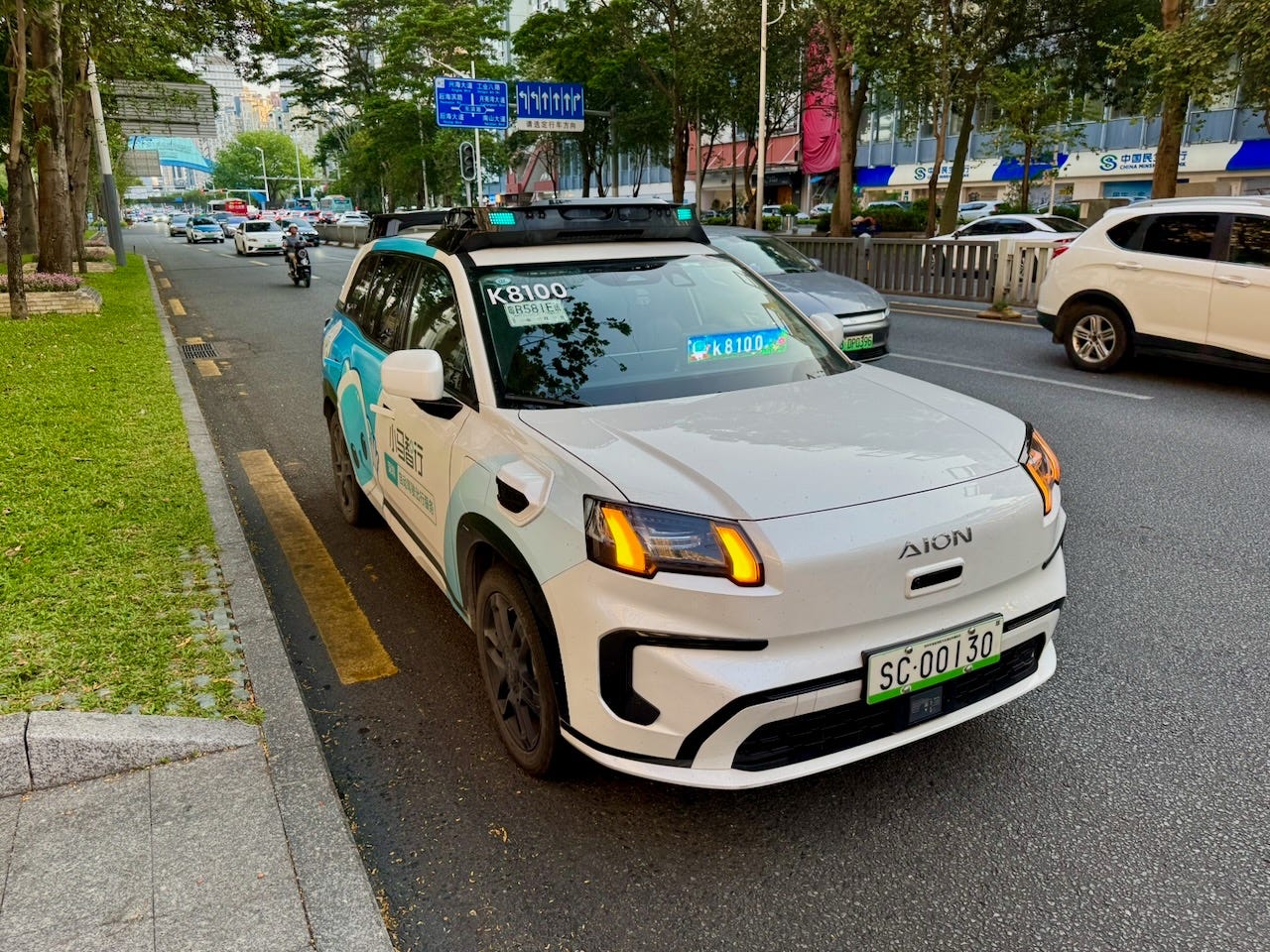
I read the primary text riding in a driverless Pony AI robotaxi on the way back from OCT Harbour in Shenzhen, the draft open on my iPad. Four of my holdings depend on it. I had spent the morning walking dealership to dealership, XPeng, Xiaomi, NIO, Hongqi, with a HeyTea somewhere in the middle as a concession to the June heat. By the time I got in the car, I needed to know whether what I had seen on those showroom floors matched what Beijing was actually mandating. Or whether the market had misread the rule, and I had sized for a catalyst that lands in 2027 rather than a mirage that evaporates in 2026. I had a thesis. I was about to find out whether Beijing had just broken it.
It is the Ministry of Industry and Information Technology’s (MIIT) draft national standard for automated driving systems, the mandatory GB standard replacing the voluntary GB/T 44721-2024. The comment window closed on 13 April 2026; the proposed effective date is 1 July 2027.
A word on the driving intelligence ladder the rest of this piece leans on. L2 still needs a human watching the road. L3 lets the car drive itself within defined conditions while a person stays ready to take back control. L4 removes the human inside a defined zone altogether. The draft standard is written for L3 and above, which is where the sensing and compute bill jumps.
The line doing the rounds is “China mandates lidar.” The text says no such thing.
What it actually says is narrower, and for my portfolio far more interesting. Clause B.3.1.5 requires fault tolerance in perception: if one sensor drops out mid-drive, a blinded camera, a lidar that stops returning, the system must still detect the road and bring the car to a safe stop. No single sensor failing may cause harm. Table B.1 sets a minimum forward detection range that climbs with speed, out to 130 metres at 120 km/h, paired with a braking capability of at least 5 m/s². The standard is technology-neutral from the first clause to the last. It never names a sensor. It mandates that the perception system keep working safely when one part of it fails, and it leaves the manufacturer to choose how.
The component reading turns the standard into a lottery ticket on one supplier. What it actually is runs duller and more durable: a performance-and-fault-tolerance bar gated by type approval, a slow, structural tailwind for the companies built to clear it. I own several of those companies. I bought them for other reasons, and this rule now tests every one.
How a safety clause turns into a cashflow
The mechanism is unglamorous, which is why it is mispriced. A car cannot be sold in China without clearing China Compulsory Certification (CCC) type approval. The new standard makes the safety case, and the documentation behind it, the thing you clear. A single-perception-fault tolerance bar, plus a minimal-risk-manoeuvre clause forcing an unaided lane change to a safe stop, is expensive to prove. They reward manufacturers with scale, capital, and regulatory standing, and they raise the sensing and compute content that has to sit on an L3 car to pass.
The standard does not put a number on that content uplift. That it raises content per L3 vehicle is a structural read, mine, built from the clauses, not a figure printed in the text. What I am sure of is the direction, and it reaches the suppliers before any single carmaker’s brand. Who captures it is the question the rest of this piece is really about.
Where each holding sits on the line
I did not buy any of these names for this standard. I bought them earlier, for their own reasons, and the rule is a test of whether those reasons still hold. Four of the six sit in my Ventures sleeve, two in Growth. I own the stack rather than a single badge for a simple reason: I cannot tell you which Chinese carmaker brand wins the autonomy war, and owning the suppliers means I do not have to.
Start with the Ventures sleeve.
Hesai is the global leader in automotive lidar, ranked first in ADAS main lidar at roughly 43 per cent share in 2025, and the first lidar maker to post a full-year profit on a GAAP basis. Its moat is scaled, cost-down, automotive-grade manufacturing with in-house chip design, turning out a unit roughly every 10 seconds, with its ATX sensor heading toward about US$150 in 2026. I own it as the picks-and-shovels supplier that gets paid by sensor content per car, whoever wins the showroom; it is the lidar position I added on the L3 certification path. The 2025 numbers are strong on their own terms: full-year net revenue of RMB3,027.6 million (~US$432.9 million), up 45.8 per cent; a first full-year GAAP net income of RMB435.9 million; and shipments of 1.62 million units, up 222.9 per cent.
Here is the nuance I refuse to gloss. That 2025 revenue is overwhelmingly an ADAS story at a blended selling price near US$260, down from about US$530 the year before as cheaper ADAS units crowded the mix. The L3 content thesis is forward. Hesai is the confirmed lidar supplier for Mercedes-Benz models enabling L3, announced on 19 May 2026. Separately, a week later, it secured a different win: an order exceeding 1 million units from a second, unnamed top European maker across more than 10 of that group’s China joint-venture models. Its multi-lidar design wins with Li Auto, Xiaomi, and Changan start production across 2026 and 2027. The company’s own guidance is 3 to 6 lidars per L3 vehicle, roughly US$500 to US$1,000 of content. That is Hesai’s guidance, not the regulation, and I hold it at arm’s length. I am not buying a 2025 revenue line. I am buying the design-win book that converts as those programmes reach start of production. What the book is worth turns on one number I cannot yet see: how much of the won volume ships at three-to-six-lidar L3 content rather than single-lidar ADAS. So I size for the wins already entering production, not the full book at full content, and I read the start-of-production dates as the conversion happens rather than waiting on a single 2027 print.
Horizon Robotics is the compute leg of the same thesis, one layer up the stack. It is China’s leading domestic ADAS compute and system-on-chip supplier, the Journey series, and the credible domestic alternative to NVIDIA, embedded across China’s top-10 carmakers with switching costs that bite mid-programme. That lock matters more in cars than in most of tech: once a chip is designed into a platform, swapping it mid-cycle is close to restarting the programme, so a design-win is not a single sale but a claim on that model’s revenue for its whole production life. Horizon is sitting on design-wins across more than 400 models, and that book is the thing I am actually buying.
Its share of the domestic-brand basic ADAS market is 47.7 per cent; its share of the broader mid-to-high-end intelligent-driving segment is a more modest 14.4 per cent, just behind Huawei at 15.2 per cent. FY2025 revenue was RMB3,758 million, up 57.7 per cent, with the high-end, NOA-capable hardware reaching 45 per cent of Journey volume, nearly 5 times its 2024 share. There is a second pull underneath all of this that I do not need to forecast to act on: export controls on the most advanced NVIDIA parts, and the wider push to localise compute inside China, move carmakers toward domestic suppliers whichever way the raw-performance race runs. That is a policy-made demand pull, not a call to buy, and it tilts the ground in Horizon’s favour. I own it for the part of the thesis that does not depend on which sensor wins: whether redundancy is met with more lidar or with more cameras and more compute, the compute content rises, and Horizon gets paid. The base is still overwhelmingly L2 and L2-plus, so the L3 uplift is optionality, not current revenue. And the company lost RMB10.469 billion in 2025 with research and development running at about 137 per cent of revenue, while one customer, its Volkswagen joint venture, was 37.6 per cent of revenue in the first half of 2024. I looked at that figure for a while. That is a deliberate land-grab burn, but it is still a burn, and I would be lying if I said the size of it sits easily with me. This is the nature of venture investing.
The car I was sitting in when I read the draft belongs to this position. Pony AI is my L4 position, and it sits on a different clause of the same rulebook. It runs robotaxi and robotruck fleets, its Gen-7 cars built with Toyota and GAC Toyota, and it has reached city-wide unit-economics breakeven in Guangzhou and Shenzhen. The reason I treat L4 as a commercial-fleet business and not a feature that arrives in the car you own is unit economics. A fleet operator can spread one remote safety operator across a growing number of vehicles. In Shenzhen, Pony has pushed that ratio to about one operator per 30 cars, with the wider fleet nearer one to 15 and heading the same way, while an individual owner can never amortise a safety net across anything but a single car. That is why city-wide breakeven on the Gen-7 fleet is the number that matters, and why L4 in a private car stays marketing rather than a business.
I own it as an asymmetric venture bet on L4 commercialisation against genuine failure risk, and it is also a Hesai lidar customer, so it sits downstream of the same sensing leg. The distinction that matters: Pony’s regulatory exposure runs through the L4 framework, Appendix C, not the L3 Appendix B redundancy clauses that drive the Hesai and Horizon content thesis. I will not conflate them. The 2025 revenue was US$90.0 million, up 20 per cent, split robotaxi US$16.6 million, up 128.6 per cent, robotruck US$40.6 million, effectively flat, and licensing US$32.8 million. Q1 2026 revenue jumped to US$34.3 million, up 145 per cent, and the fleet passed 1,700 by late May with a 3,500 target by year-end. It is pre-operating-profit, the one GAAP-positive quarter came from a mark-to-market gain rather than operations, and the robotruck line is going nowhere fast. I size it accordingly.
XPeng is the one I own partly as a hedge against my own thesis. It is a mass-market smart-EV maker, 429,445 deliveries in 2025, up 126 per cent, and its edge is in-house foundational driving models and its own Turing compute rather than sensor content. It has moved to a pure-vision stack and dropped lidar from its new models. Its G7 Ultra runs three Turing chips at about 2,200 TOPS with no lidar at all and is billed as the first L3-compute production car; it holds an L3 road-test permit in Guangzhou from December 2025. The tie-in is uncomfortable and useful, and the discomfort is specific: owning something that argues against my own thesis sits differently in the portfolio from anything else I hold. XPeng adds essentially zero lidar content. If the Chinese market ends up looking like XPeng, my lidar leg is narrower than I would like. Holding it keeps me honest about the counter-case, and it gives me exposure to the software-and-compute path if that is the one that wins.
Then the Growth sleeve.
BYD I have covered at length before, so one line here: God’s Eye reached more than 2.5 million cars by December 2025, but the mass-market tier carrying the bulk of that volume runs no lidar, only the premium Denza and Yangwang tiers do, and the first L3 test licence has not turned into a commercialised L3 product.
Geely is the multi-brand group, Geely, Galaxy, Lynk and Co, Zeekr, that sold 3.02 million vehicles in 2025, up 39 per cent, with NEV sales of 1.69 million, up 90 per cent. I own it for NEV volume and margin recovery, but on this thesis the load-bearing reason is the Zeekr hedge: a mass-market group with a real premium tier sitting on top. Its G-Pilot ladder runs from camera-led mass trims with no lidar up to the ZEEKR 9X, which carries multiple lidars and is described as designed for L3, though L3 there is a future capability, not a certified one. That ladder is why I hold it. If the redundancy bar lifts content at the top of the market, Geely captures it through Zeekr without betting the whole group on L3 arriving on schedule; if the mass market stays camera-led, the volume and margin story still pays. It is the carmaker position that does not depend on which way the sensor-mix question breaks.
Of the six, only Hesai has revenue mechanically tied to autonomy sensor content today, and even Hesai does not break that revenue out by autonomy level. Horizon is the next most exposed, through compute, but mostly at L2-plus. The carmakers are L2-plus volume stories with L3 still aspirational, and Pony is L4. So the L3-content thesis is forward and supplier-side, not a 2025 revenue line.
The risks that matter, and holding through them
That is the base case. Here is what collapses it. The strongest objection to my own thesis is sitting in my own book. The standard is technology-neutral, which means redundancy can be met with cameras, radar, and more compute rather than more lidar. XPeng’s G7 Ultra clears its own L3-compute bar with no lidar at all. The mass market is going the same way: BYD’s mass tier and Geely’s entry trims are camera-led. The data is genuinely split. Aggregate lidar adoption is still rising, around 3.21 million passenger-vehicle installs in China in 2025, up about 110 per cent, with penetration near 18.5 per cent by December, and the premium L3-aspirant tier is stacking multiple lidars. But below roughly RMB200,000 the volume is going camera-led, and falling lidar prices, an L2 unit near US$200 now, cut both ways: they widen the market and they cap the per-car content story at the bottom.
My read is hybrid tiering, not a single winner. Hesai’s lidar leg is validated where it matters commercially, the high-value L3 programmes and the European wins, and capped in breadth by a camera-led mass market. Horizon is the leg that does not depend on which way the sensor mix breaks, though that is not the same as saying its own balance sheet cannot break.
Then timing. The standard is still a draft. The comment window closed on 13 April 2026 and the final text has not been published, so I am treating that April close as the live fact. If the effective date slips past mid-2027 or the redundancy language is watered down, the catalyst dilutes. Since the supplier revenue is already weighted to 2026 and 2027, I am underwriting a wait in any case.
This is where the psychology does the real work, and it is the part I care most about. Four of these are Ventures-sleeve positions, sized at entry so that I can hold them through exactly this kind of uncertainty without ever being forced to act. The catalyst I am waiting on prints in 2027, not this quarter. The temptation with a regulatory thesis is to trade every headline: the draft, the comment close, the next earnings call, the next robotaxi incident. I am deliberately not doing that. I sized these as venture bets precisely so that a slipped date, a soft quarter, or a competitor's bad week, like the temporary regulatory pause that followed a rival robotaxi fleet stalling on 31 March 2026, does not put me in the one position I never want to be in: selling something good at the wrong time because the balance sheet made me. I have been there once, and the balance sheet had nothing to do with it. I owned the position on borrowed conviction, never made the thesis my own, and when it wobbled my nerves sold it for me. The worst feeling in investing is not the money. It is knowing I sold the right thing for the wrong reason, and that the reason was me. Holding power is something I build on purpose, and it runs on conviction I own rather than borrow.
The signal I am actually counting
The rule tells me the bar went up. It does not tell me whether it went up in sensing or in compute. The number that settles it is the average lidar and compute content on the 2027 model-year cars actually approved under the final standard. If those approvals come in at or above the 3-to-6-lidar band, the sensing leg is confirmed and Hesai’s design-win book converts into revenue. If they cluster on camera-led stacks with one lidar or none, I retreat to the compliance-and-capital leg and lean harder on Horizon’s compute, which gets paid either way. That is the test, and it is falsifiable.
Beijing did not mandate lidar. It mandated that no single sensor failing may cause harm, which is a harder bar, and it is the one my suppliers are built to clear. The approval sheets for the 2027 cars will tell me how much lidar and compute the final standard actually forced onto them, and that is the number I will be counting.
As of the date of publication, I hold positions in Hesai (NASDAQ: HSAI), Horizon Robotics (HKEX: 9660), Pony AI (NASDAQ: PONY), XPeng (HKEX: 9868), BYD (HKEX: 1211) and Geely (HKEX: 0175). Positions may change after publication without notice. Cohong Lane is a periodical publication made generally available to the public; this is disclosure of my positions, not a recommendation to buy, sell, or hold any securities. Full disclaimer · About Philip.
Your publication aligns with a lot of what I enjoy reading. I've subscribed!