


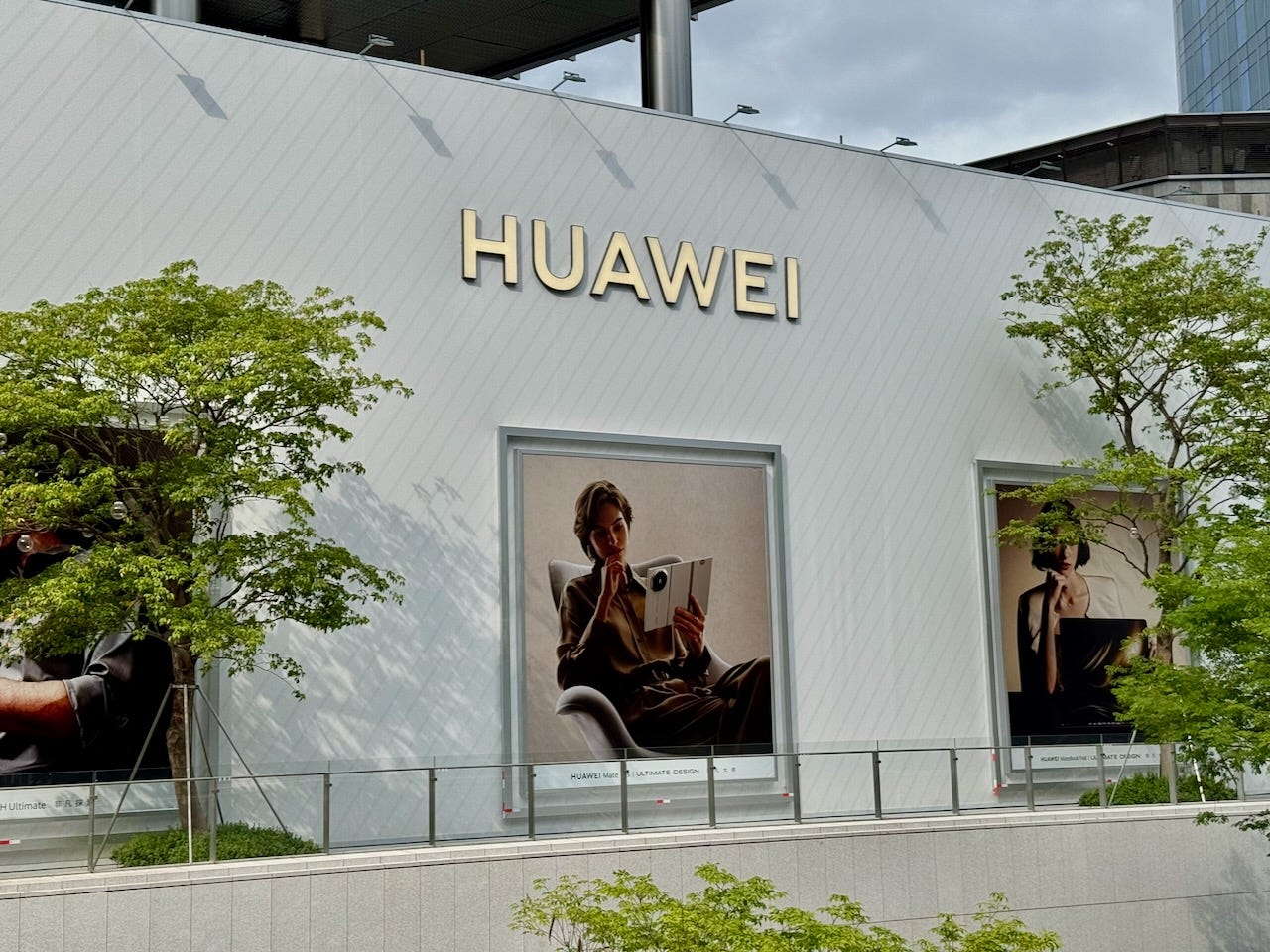
I went to Chongqing to stress-test 3 China EV positions I already hold: BYD, Geely, and XPeng. I’ve written separately about what that trip taught me about my portfolio — but the question that kept forcing itself into my notebook wasn’t about any of them. It was about Huawei. More precisely: how Huawei gets paid by an industry whose private P&L will never tell you. The answer is on file in Hong Kong — not in Huawei’s accounts, but in the procurement ledger of the assembler that builds the cars Huawei sells.
I keep seeing what people call “Huawei cars” on the street — whether I am in Chongqing, Guangzhou, or Shenzhen. More precisely: AITO vehicles displayed and sold inside Huawei’s own retail footprint. In Chongqing I went into one of those stores. The staff lead with HarmonyOS, ADS, and the cockpit experience. But Huawei doesn’t build a single car. SERES — the Chongqing-based assembler — does.
SERES has now reported its FY2025 audited results, filed on HKEX on 30 March 2026: revenue RMB 164.9 billion (~US$22.7 billion), up 13.6% year-on-year; attributable net profit RMB 5.96 billion (~US$0.8 billion), essentially flat. Overall gross margin expanded approximately 3 percentage points to 26.88%. Top line growing, gross margin expanding, attributable profit flat. Standing in that Chongqing store, the question I couldn’t shake was simpler: if the assembler is generating real gross profit on a far larger revenue base, where is the operating leverage going at the net line? The number, in SERES’s procurement lines, is larger than I expected.
What follows is my attempt to answer that with primary filings and careful inference. Huawei is private, so I cannot prove its unit margin from any primary source — the case I can build is one of dependency rather than profit extraction, and dependency is the more important variable. This is how Huawei captures EV economics without building a car, and what it means for the Chinese manufacturers I hold.
What does a “Huawei car” look like on the ground?
On the ground, a “Huawei car” is an AITO vehicle displayed and sold inside Huawei’s own retail footprint, pitched entirely around HarmonyOS, ADS, and the cockpit experience. The assembler — SERES — is never mentioned. The brand on every wall is Huawei. The product being sold is the cabin, not the car.
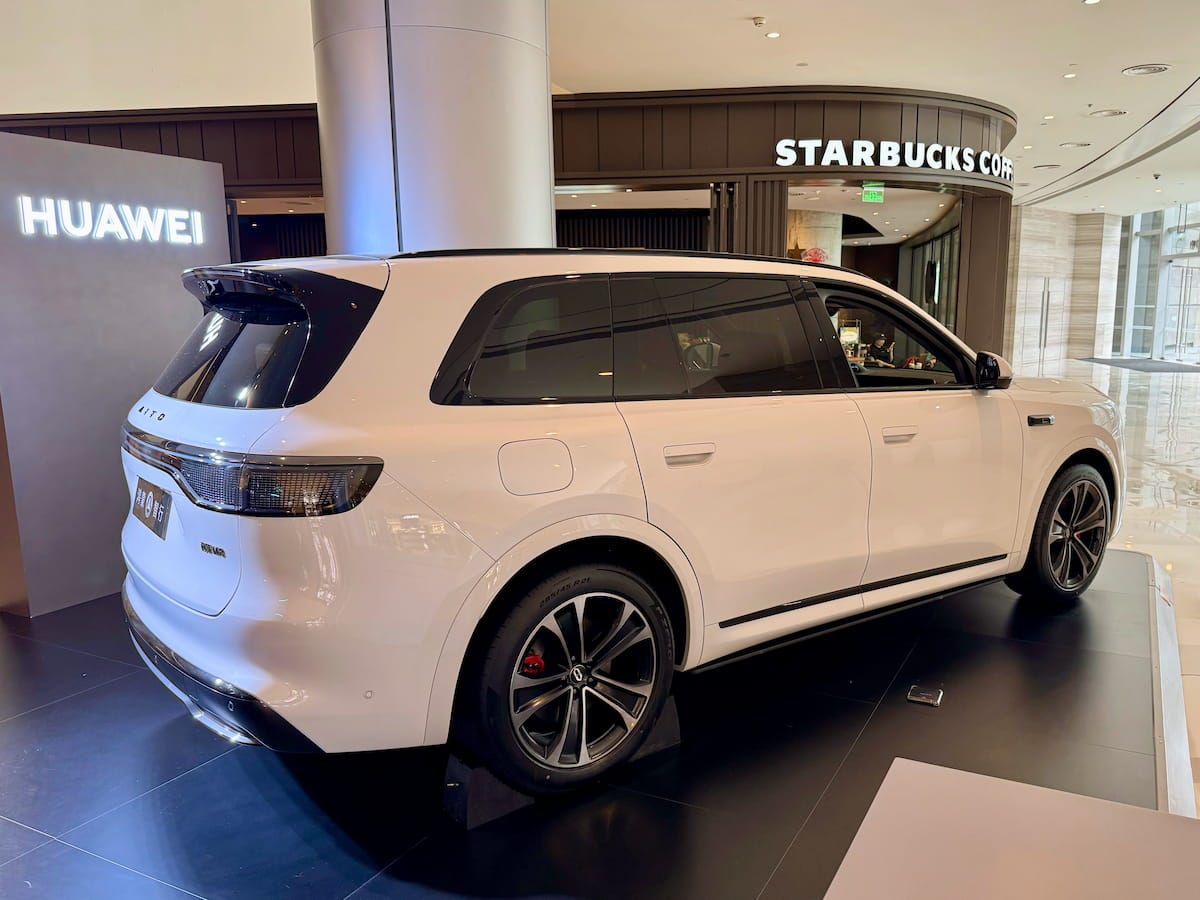
The Huawei store in Raffles City Chongqing sits on an upper floor overlooking the confluence of the Jialing and Yangtze rivers — premium real estate, premium context. It’s set up less like a showroom and more like a personalised tech consultation. A staff member walked me through the car as if the vehicle itself were almost a formality: HarmonyOS, the ADS stack, the cockpit display, the seat experience, the audio environment. Horsepower was never mentioned. Neither was the drivetrain. Neither, notably, was SERES — the company that actually built the car sitting on the floor. The brand on every wall was Huawei. The pitch was the experience. The car was hardware.
That observation is not proof of anything on its own. But it calibrates how seriously to take what the industry calls the “third living space” — the idea, now mainstream in Chinese premium EV marketing, that the cabin itself is the product: screens, audio, lighting, near-flat bed seats with heating, massage and cooling, voice and gesture controls, and the ambient sense that the car is woven into your daily life. The drivetrain is assumed. The shell is almost incidental.
That framing tells you who holds the structural advantage. Huawei already wins in two living spaces — the home and the pocket. The car is the next one.
The open strategic question — whether HarmonyOS becomes the premium default in China the way CarPlay and Android Auto became defaults in the West — runs underneath everything that follows.
How does Huawei get paid without building a car?
Through procurement, not profit-sharing. In 2022, SERES purchased RMB 5.8 billion (~US$0.8 billion) from Huawei. In 2023, RMB 7.2 billion (~US$1.0 billion). In 2024, RMB 42 billion (~US$5.8 billion) — 30.2% of total purchases. In FY2025, RMB 56.1 billion (~US$7.7 billion) — 33.78% of total purchases, a new high. The FY2025 annual report names the largest supplier only as “IT, communications, and hardware equipment”; Chinese financial media identify it as Huawei. Cumulative procurement from 2022 through FY2025: approximately RMB 131 billion.
The SERES IPO prospectus is explicit:
“Our collaborations with Huawei do not involve any arrangements regarding profit-sharing, which are consistent with industry norm according to the Frost & Sullivan Report.”
The FY2025 annual report does not amend that arrangement. “No profit-sharing” does not mean “no economic transfer”. It means the transfer happens through ordinary operating lines — procurement and, likely, the retail channel. RMB 56 billion flowing to a single supplier tells me exactly who controls SERES’s cost stack — and it isn’t SERES.
To understand what that number actually means, it helps to put it in context. Apple’s dependence on Foxconn at its peak — the period that prompted Apple to spend a decade deliberately diversifying toward Pegatron, Luxshare, and Indian assembly — ran at roughly 25–30% of COGS. SERES is already at 34%, and rising. The difference is that Apple owned the brand and the customer relationship. In the Huawei store in Raffles City, it was impossible to tell who did.
The strongest counter-argument to this framing is that procurement is not profit. RMB 56 billion is top-line revenue for Huawei's automotive business, not a margin number, and I cannot prove Huawei's unit economics on those components and services from any primary filing. Huawei could in principle sell at or near cost, treating SERES as a platform anchor rather than a profit centre. I doubt it: Huawei's 2024 annual report disclosed that its intelligent automotive solutions unit turned a profit for the first time, and software-and-cockpit revenue carries software-margin economics, not commodity-component economics. What I can prove is the dependency, and dependency is the more important variable. Whether Huawei is currently extracting profit or simply locking in the platform position, the result for SERES is the same: a third of every yuan it spends on inputs goes to one supplier, and that share is climbing.
SERES’s selling expenses ran RMB 24.2 billion (~US$3.3 billion) in FY2025 — 14.7% of revenue, up from 13.2% in 2024. Consistent with what you see on the ground: premium stores, premium service, and a sales story led by the platform brand, not the assembler. SERES still posted a 3.6% attributable net margin in FY2025 (4.1% in 2024) — proof the assembler can be profitable in the Huawei era. But profitable with a cost structure where Huawei is the largest single supplier, where the share of inputs going to that supplier rose by another 4 percentage points in the most recent year, and where revenue grew 13.6% while attributable profit did not move at all.
What happens when Huawei replicates the platform?
Huawei is already doing it, and the cumulative volume across the Harmony Intelligent Mobility Alliance (HIMA) — Huawei’s smart car joint-venture framework through which it supplies ADS, HarmonyOS, and hardware to OEM partners without taking an assembly stake — settles the question. HIMA delivered 112,700 vehicles in Q1 2026 (+41.9% YoY), bringing cumulative deliveries to approximately 1.35 million units by March 2026. The AITO M9 alone has now passed 280,000 cumulative deliveries and outsold BMW X5, X7, Mercedes GLE and GLS in China on a cumulative basis. The AITO M6 took 60,000 pre-orders in the first 24 hours of pre-sale on 23 March 2026. The platform isn’t trying to scale. It has scaled.
The share split tells the same story. Five brands now sell across 4 assemblers: AITO at SERES, LUXEED at Chery, STELATO at BAIC, MAEXTRO at JAC, SHANGJIE at SAIC. AITO’s share of HIMA fell from above 85% in 2024 to roughly 63% by November 2025 as new brands joined; it has since recovered to roughly 69–76% in Q1 2026 as the non-AITO ramp ran slower than expected.
The structural implication is not “Huawei wins”. It’s that platform scale changes OEM bargaining power over time. SERES can be profitable and still become more dependent — and those two things are not in contradiction.
SERES has responded on 3 fronts — none of them the moves of a comfortable partner. They are the moves of a company managing a dependency it knows is structural.
Trademark reclaim. In July 2024, SERES paid RMB 2.5 billion (~US$0.3 billion) to buy 919 AITO trademarks back from Huawei. A company paying to own the customer identity it built in partnership tells you something unambiguous about who the brand equity originally belonged to.
Technology stake. SERES invested RMB 11.5 billion (~US$1.6 billion) for what was originally a 10% stake in Huawei’s Yinwang autonomous driving unit, now diluted to 9.36% as Huawei admitted other partners. The FY2025 annual report recognised approximately RMB 170 million of equity-method income from this stake — accretive at the income line, but a 1.5% return on capital implies the investment is a strategic lock-in, not a financial one. Changan’s AVATR made the same move independently at the same percentage. This is becoming standard practice for HIMA partners who want a seat at the technology table rather than just a supply agreement.
Capital raise. SERES listed in Hong Kong on 5 November 2025, raising approximately US$1.7 billion in fresh capital.
The platform toll and my portfolio
The thesis is simple: Huawei has inserted itself into the value chain, the customer relationship, and the standard-setting layer of Chinese premium EVs — without taking assembly risk.
I didn’t go to Chongqing to find a new stock. I went to stress-test positions I already hold — and Huawei is now inside that underwriting.
The risk isn’t that BYD, Geely, or XPeng can’t build EVs. It’s that Huawei is redefining what Chinese consumers are paying for in the premium segment. Not the drivetrain. The cabin.
Two mechanisms are at work, and they break differently. For HIMA partners — SERES, Chery, BAIC, JAC, SAIC — the toll is procurement, visible at SERES’s 33.78%. For the three I hold — BYD, Geely, XPeng — the risk is competitive displacement: if HarmonyOS becomes the premium default, their in-house cabin stacks become an expense rather than a moat.
BYD has the scale to respond — but only if Denza and YangWang can match the Huawei experience baseline, not just approach it. Geely’s Zeekr is betting in the opposite direction: building its own independent cabin stack (ZEEKR AI OS, Qualcomm Snapdragon 8295) rather than paying the Huawei platform toll. The risk isn’t dependency — it’s irrelevance. If Chinese consumers decide HarmonyOS is the definitive premium standard, Zeekr’s in-house software investment becomes a sunk cost. XPeng built its own stack as a moat; that same stack becomes an expense if HIMA reaches parity fast enough.
I’ll be direct about the uncertainty here: I don’t know which of these resolves first, or how fast. But these are the 3 data points that would change my view:
The experience gap. The market is already bifurcating along integration lines. My base case is that the gap widens through 2026 as HIMA launches new models at pace. The break condition for my OEM positions: BYD (Denza or YangWang), Geely (Zeekr), or XPeng demonstrably matching HIMA cockpit benchmarks in independent comparisons by H2 2026. Until then, Huawei is setting the floor.
HIMA’s spread. AITO fell from 85%+ of HIMA volume to roughly 63% in November 2025, then recovered to 69–76% in Q1 2026. If it falls below 50% on a sustained basis, Huawei no longer needs SERES to anchor the platform — and SERES loses whatever negotiating leverage it currently holds. If it stabilises above 60%, the relationship is maturing into something bilateral enough to be manageable. The current data point sits in the second camp, but Q1 monthly figures swing widely.
The procurement mirror. 33.78% and rising at SERES. As of late April 2026, none of the FY2025 annual reports filed by Changan, BAIC BluePark, JAC, or SAIC show Huawei or Yinwang as a top-five supplier or named related-party transaction at the parent-group level — most likely because the brand-level volumes are still too small to register in parent-group COGS. AVATR has filed for a Hong Kong IPO at a reported US$4.6 billion valuation; when it lists, its prospectus and first annual filing will be the next clean read. Three HIMA partners showing 25%+ procurement dependency would be the clearest possible signal that Huawei has restructured the cost stack of the Chinese premium segment — invisibly, without building a single car.
I hold my positions. But I’m now measuring each of them against one question: can they compete on the thing Huawei is actually selling? SERES’s procurement lines already show what the platform toll costs. The next 18 months will tell me which other OEMs have been paying it all along.
Cohong Lane is where I publish the work I do on the China positions I actually hold — written from Hong Kong, sourced from HKEX filings, calibrated against what I see in the cities where these companies operate. The next piece from the Chongqing trip is I Own BYD. Chongqing’s 11-Day Train Changed My Math. — on the rail corridor to BYD’s Szeged plant that I had not modelled before visiting.
As of the date of publication, I hold positions in BYD (HKEX: 1211), Geely Automobile (HKEX: 0175), and XPeng (HKEX: 9868). Positions may change after publication without notice. Cohong Lane is a periodical publication made generally available to the public; this is disclosure of my positions, not a recommendation to buy, sell, or hold any securities. Full disclaimer · About Philip.