


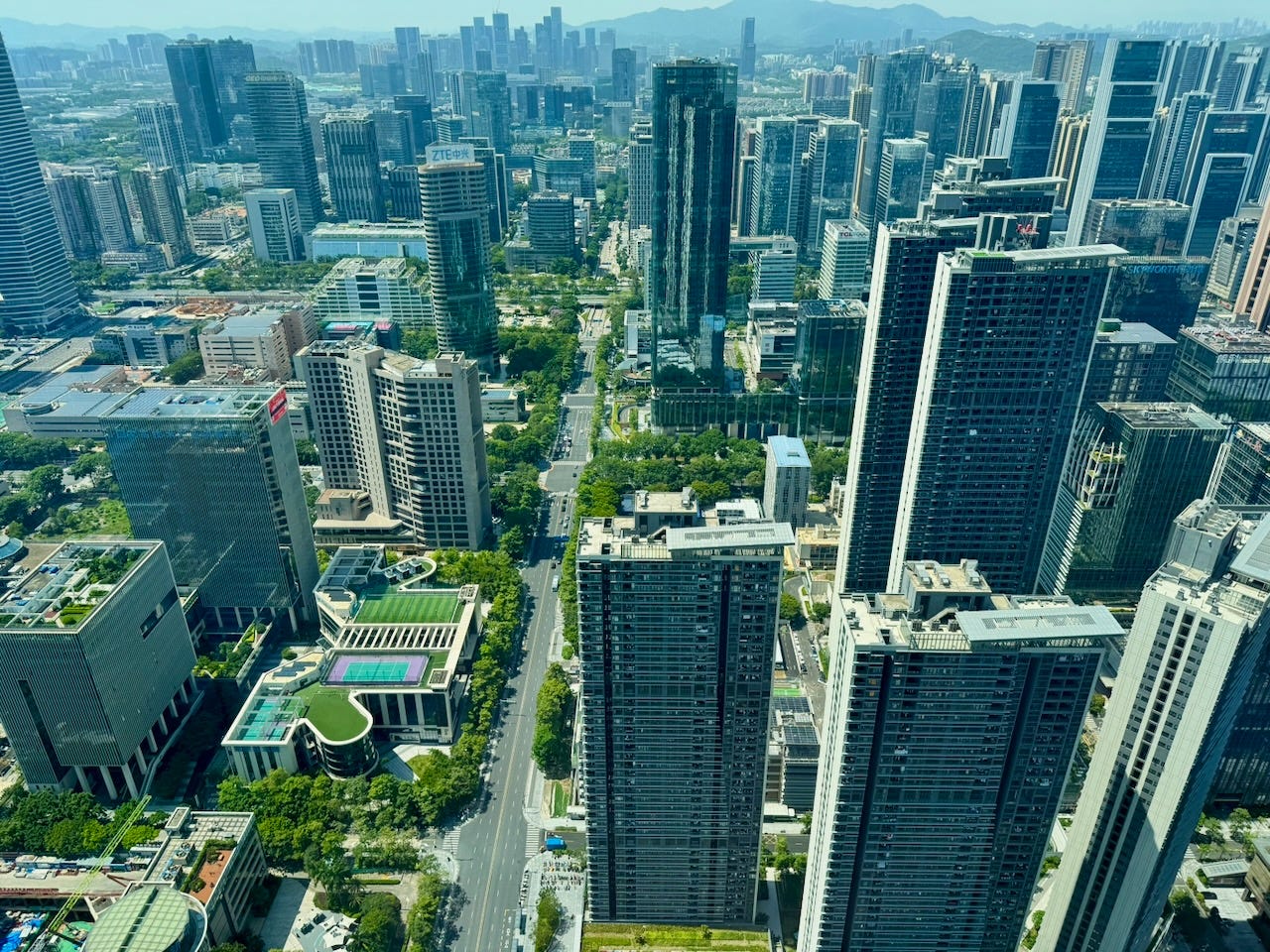
On 23 July, two ministries in Beijing published 22 pages setting out what China should build in renewable energy capacity between now and 2030. I own three companies the new plan affects. I decided to read it over lunch at my favourite dim sum restaurant on the 58th floor of the Renaissance Shenzhen Bay.
The largest of the three is Beijing Jingneng Clean Energy Company (Jingneng), a Hong Kong-listed, Beijing state-owned wind and solar operator. It is 2.3 per cent of my income book, fully sized, and pays me about 8 per cent a year on cost, for as long as it holds.
Its wind fleet was forced to stop generating 11.09 per cent of the time in 2025, against a national average of around 6 per cent, the worst curtailment rate of my three holdings. The plan does not fix that. What it does is add a cost to everything Jingneng builds next.
China is committing to less than half the new capacity of what it installed last year, and that is the number every journalist will quote. It is also the softest line in the document. The rule underneath it has never appeared in a Chinese renewable plan before.
What the Outline left out
The renewable energy plan sits under the 15th Five-Year Plan Outline, the document I aligned my portfolio against in March.
The Outline stated that the non-fossil share of energy production must rise. No output number was given. This sector focused plan is where the numbers appear. Two of the numbers are binding. The rest is direction of travel as I have outlined in the table below.
Three numbers matter to me: namely how much gets built, how hard each installed kilowatt has to work, and how much output the grid can count on when demand peaks.
The first is a floor. 2,800 gigawatts (2.8 billion kilowatts) of wind and solar by 2030, up from 1,840 at the end of 2025. Spread over five years, that is 192 gigawatts a year. China added 438 gigawatts in 2025, more in a single year than the United States has installed in total.
Judging by the previous plan, the floor is a minimum China expects to beat. The June 2022 renewable plan was beaten by around 18 per cent. I read it as permission to slow down rather than a decision to halve the build outright. Either way, the volume number is not what decides what my three companies earn. If they build more, each new centralised project, meaning a utility-scale station rather than rooftop solar, has to fund a reliability requirement the last one did not face.
Nobody in Beijing has lost interest in renewables. China promised the world 1,200 gigawatts of wind and solar by 2030 and passed it in 2025, five years early. What is scarce now is somewhere for the power to go.
In Q1 2026 the grid took only 91.4 per cent of the wind power China’s turbines produced, and 90.6 per cent of the solar. The rest was curtailed: generated, then turned away, with the operator absorbing the loss. Four provinces threw away more than a tenth of the solar power they generated last year. When the two ministries write that they want reasonable revenue and return per kilowatt-hour, they are describing a sector that has been building itself into a loss.
My view is that a higher capacity grid is the fix, but that sits mostly in the parent energy plan. The long-distance lines that carry power from the remote, windy north to the cities in the east go from 340 gigawatts of capacity today to at least 420 by 2030. Eighty gigawatts of new transmission capacity over the five years, against at least 370 gigawatts of new wind and solar going into the same northern provinces over the same period.
The second is how hard the fleet is expected to work, and it is what lets a smaller capacity build produce the clean electricity Beijing wants. Across China’s wind and solar fleet, a kilowatt of capacity runs the equivalent of about 1,250 hours flat out today. The plan’s own numbers imply about 1,430 by 2030. That is roughly 15 per cent more electricity from the same hardware.
The measure counts only the power the grid actually absorbs, so anything curtailed does nothing for it. Some of the gain will come from better hardware in more ideal locations, though most of it, I suspect, has to come from turning less power away, more transmission capacity where the lines can be built in time and storage everywhere else.
The third is different: not a target but a standard a new wind or solar farm has to meet, and it is the one that actually costs money.
The rule that costs money
By 2030, every new centralised wind or solar station is meant to guarantee that a tenth of its capacity will be available when the grid runs short of power, with 95 per cent certainty.
A 100 MW wind farm has to show 10 MW on the coldest January evening, when heating demand across northern China peaks, the sun has gone down, and the grid has nothing spare. Batteries built alongside the turbines count towards the guarantee.
A wind farm used to be judged on a whole year’s output. Wind does not blow to a timetable, so the only way to be certain of delivering on that one evening is to have stored some beforehand.
That is where the build cost goes up. A project that used to need turbines, a substation, and a grid connection now needs a battery and the forecasting to support it. None of it generates an extra kilowatt-hour. Beijing scrapped the old rule forcing developers to bolt storage onto every project in February last year, as wasteful. This brings it back, as a standard the operator has to hit, not the blanket quota it used to be.
The plan promises to establish, in an orderly way, a capacity payment: a mechanism that pays an operator simply for being available, whether or not it generates anything that day. It does not say when, or who pays.
The capacity compensation will arrive eventually. Beijing has paid for availability before. The question is when, because the build cost on new projects starts now, and the best argument against assuming soon sits in Jingneng's accounts. Beijing promised early wind and solar projects an above-market feed-in tariff, but fell years behind paying it. It was still clearing those arrears in 2025. I am not underwriting this position on the money arriving within two years, or three.
The plan does not say what happens to a developer who misses the standard. My read is that the grid connection is the choke point. A station that cannot show a tenth of its capacity at the winter peak will struggle to get connected.
What is holding up Jingneng’s 8 per cent
Jingneng’s wind fleet is mostly located in Inner Mongolia, and its gas and heat business supplies Beijing. In 2025 it produced about 17 per cent more wind power than the year before and still earned less: profit attributable to shareholders fell 9.16 per cent. The company has promised to pay out a rising share of profits as dividends, 42, 44, and 46 per cent across 2025 to 2027. A rising share of a falling number is not a rising dividend, and I live off these dividends.
Two one-off items held the 8 per cent up last year. Beijing paid back RMB 4,404 million (~US$610 million) of overdue subsidy, 2.96 times what it paid the year before. Roughly a quarter of the distribution was a fifteenth-anniversary special dividend. Neither is a reason to expect the same again.
Curtailment is why more output did not mean more profit. Jingneng’s rate was 11.09 per cent in 2025, down from 11.79 the year before. A ninth of what its turbines produced was thrown away. Transmission fixes that, and transmission is not in this plan.
The plan puts Jingneng in the right physical location because its fleet sits in the clusters the document names, Ulanqab, Xilingol, and the Chagannur export project. This is exactly where most of the new northern capacity is headed. That is also the problem. The capacity arrives before the transmission lines do, and none of the lines is dated before 2030.
At the 28 July half-year meeting, which is five days after the plan landed, the company chairman flagged a downward trend in operating indicators. He called the gas plants the ballast, and tied flexibility retrofits to capacity tariff policy. What is squeezing the payout today is older than the new reliability rule, which only applies to what Jingneng builds next: curtailment nobody has fixed, and a dividend still propped up by money Beijing owed the company years ago.
Stronger or weaker: impact on my three positions
My two other renewable energy positions are China Resources Power, which runs renewables and coal plants side by side, and Huaneng Power International, one of the five big state generators. The reliability standard applies only to what each of them builds next, not what they already run. New wind and solar have to buy their reliability, mostly in batteries, before they can connect. Coal already has it, and already gets paid for it. The rule adds nothing to what coal earns. What it does is make the alternative to coal more expensive, and confirm that the scarce element on the entire grid is reliable output at the winter peak.
Coal supplied 49.7 per cent of China's electricity in the first half of 2026. That is below half for the first time on record. Since January 2024, a coal plant has earned a payment for the electricity absorbed by the grid, and a second for availability. The NDRC set the standby payment at RMB 330 per kilowatt of capacity a year, with most provinces paying about 30 per cent of it across 2024 and 2025, and every province moving to at least half from this year. Carbon Brief estimates it to be 5 to 8 per cent of coal-plant revenue.
Huaneng is the largest coal owner of my three positions. It had 92 gigawatts of coal at the end of 2025, 59 per cent of a 156 gigawatt fleet.
China Resources Power (CRP) is exposed to both renewables and coal. Renewables were half of its 90 gigawatt attributable fleet at the end of 2025.
Both Huaneng and CRP already collect the grid stabilisation payment. Weighed against what each position pays me on cost, the impact across the three is uneven: net negative for Jingneng, which carries the new cost with nothing to offset it; neutral to positive for Huaneng, whose fleet is 59 per cent coal and already being paid for it; and mixed for CRP.
What would tell me I am wrong
Three things would.
The first is the money, and by itself it is not the issue. My case is that this standard is a cost with nothing behind it, so if Beijing puts a date, a payer, and a rate on the capacity payment for renewables, most of that case goes with it. Coal got all three within months, RMB 330 per kilowatt of capacity a year, and has been drawing on it since. Renewables have none of them yet. It only becomes a problem if that payment never comes.
Curtailment is the second, and the bigger of the three. It is the one I check month by month. Inner Mongolia’s wind utilisation rate, the flip side of curtailment, comes from the national new-energy consumption monitoring centre and is republished on the NEA site. Above 93 per cent for two quarters running and the lines are arriving faster than I assumed, which fixes Jingneng’s revenue without anyone having to pay for it. Below 88 per cent and it does not.
The payout is the third, and late August settles it. I have argued that 2025 leaned on the subsidy arrears and the anniversary special, and that neither comes back. If subsidy recovery holds anywhere near RMB 4,404 million, the dividend is better funded than I have given it credit for. If it falls back towards the 2024 run-rate while the payout ratio still climbs to 44 per cent, the 8 per cent is being paid out of money Beijing already owed.
There is no mechanical sell rule here. Beijing needs the power Jingneng delivers, and that buys the asset base patience. The payout is a separate question, and it is the one I live on.
The dim sum was worth the trip to the 58th floor, and I went down the lift still holding onto all three companies. The 22 pages do not change what Jingneng owns, or that Beijing needs the power it produces. The plan does change who pays to keep new power capacity dependable on the worst evening of the year, and for now that is the operator.
If you liked this article, please consider sharing it with a friend.
Word of mouth is how this publication grows.
As of the date of publication, I hold positions in Beijing Jingneng Clean Energy Company, China Resources Power, and Huaneng Power International. Positions may change after publication without notice. Cohong Lane is a periodical publication made generally available to the public; this is disclosure of my positions, not a recommendation to buy, sell, or hold any securities. Full disclaimer · About Philip.
Thanks for writing this. I really enjoyed your previous article on the 15th FYP, so it’s great to see a sector deep dive on renewables. While I’m not exposed to the sector myself, your piece was really eye-opening.