


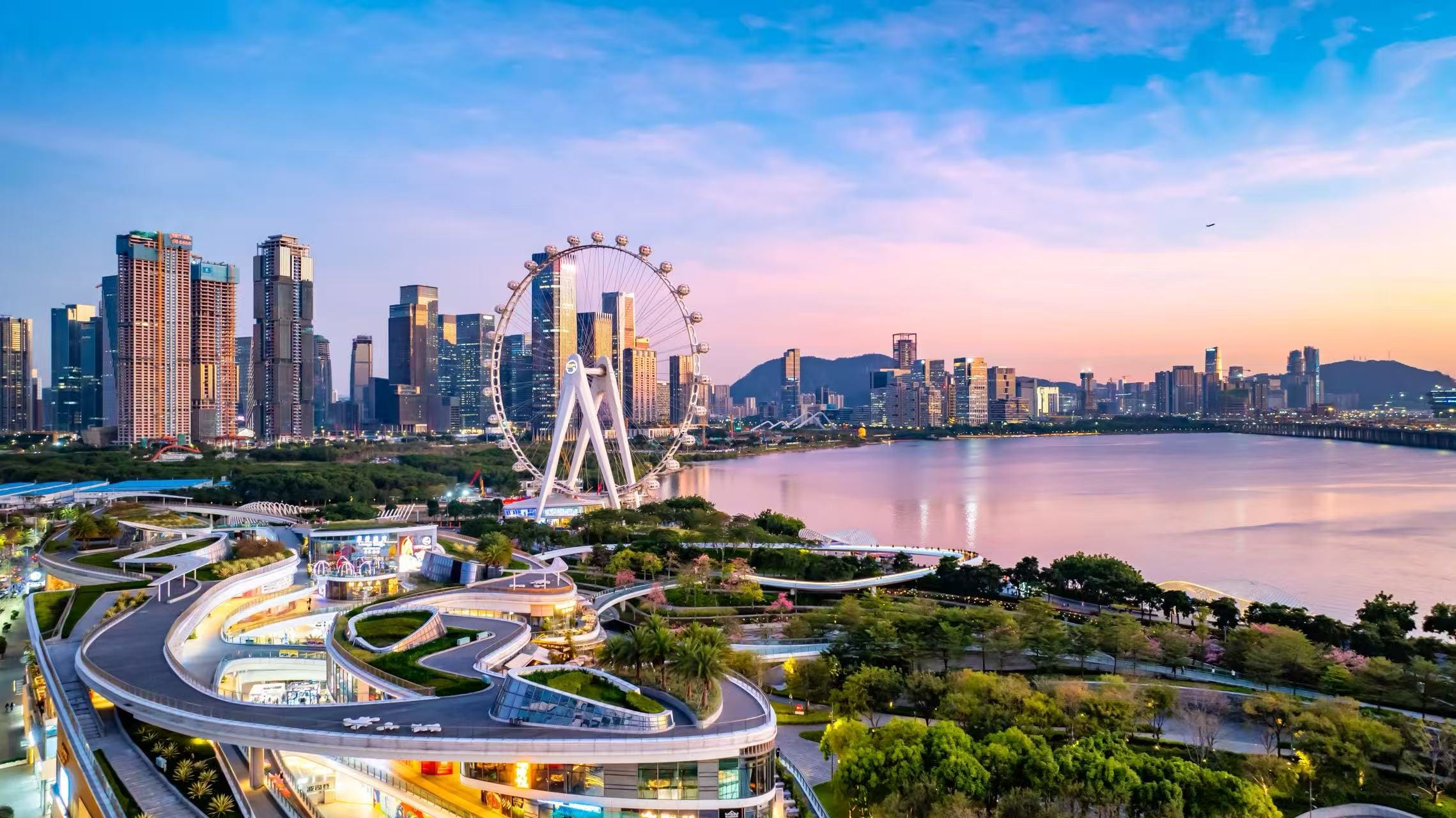
If I take the lift to the 47th floor of my apartment building, I can see Qianhai across the border. Beijing has built a copy of Hong Kong on reclaimed land in Shenzhen, and I live close enough to look at it before breakfast.
Qianhai is a special cooperation zone on the western edge of the city, built to run Hong Kong’s institutions on the mainland. On the map I am closer to it than I am to Hong Kong Island. Here is the part that surprised me: the better Beijing’s copy works, the more valuable the original becomes, not less.
I went this May as part of a German Chamber of Commerce delegation. After the border I crossed into the zone in a Pony AI robotaxi, no driver, full autonomy. A few minutes later the avenues turned wide, clean and almost empty, glass towers set back behind landscaped green, the air quiet in a way central Shenzhen never is. It does not look like a city that grew. It looks like a city that was specified, then built to the spec.
Qianhai matters because it shows what China can do when policy, capital, infrastructure and institutional design all point at the same target. The skyline is the least interesting part. The wiring is what I came to read: where money, law and state ambition meet, and where my Hong Kong view of China either gets sharper or gets exposed.
My working view after the visit: the institutional layer is real, the wiring to Hong Kong is real, but the experiment is not yet proven. Growth has more than halved from its 2023 peak, the zone still runs on large subsidies, and no published figure yet separates the firms that came for the institutions from those that came for the cheque.
Ground Truth: What I Saw Standing In It
Numbers on a plan are cheap. What changed my read was standing in the place, looking at the parts that do not fit on a balance sheet.
The delegation was not a spectator’s outing. The room read as genuine commercial interest.
The sharpest moment was the aircraft. I sat in a pink eVTOL inside the zone, and I had it filed wrong in my head before I went. This is not a prototype going nowhere. It is a production aircraft you can actually buy, the S-Zero from YIVTOL. Even static, strapped into the seat, the low-altitude economy stopped being an abstraction.
I climbed in on the ground, not in the air. The demo site is not yet approved for passenger flights, so what I watched was a demonstration lift-off, not a ride. I plan to go back to the maker’s production facility for an actual test flight, and I will report on that when I do.

Seated inside the YIVTOL S-Zero.
The YIVTOL S-Zero doing a demonstration lift-off.
The same instinct, frontier technology as marketing, showed up over coffee. In the commercial office of the Shenzhen retail robot maker Anno, where we watched the machines run live, a robot barista ground the beans, pulled the shot and finished the cup with no human hand in the loop, then used its new AI module to print my own face into the foam. It is a gimmick, and it is designed as one: the machine is built to be filmed and shared as much as to pour a flat white. But it is also the cleanest small picture of what the zone is selling, which is automation as spectacle. The low-altitude aircraft and the latte-printing arm are doing the same job, turning “new productive forces” into something a visitor can stand next to and photograph.

The finished cup, my face printed into the foam by Anno's AI module.
The same machine pulling the shot, start to finish with no human hand.
None of this is data. The delegation, the aircraft and the robot barista told me one thing only: which parts of the official story survive contact with the place. That is most of what a visit ever buys you.
By then I could see myself living here one day. I had not gone in expecting that. That pull is the reason I am trying to read it honestly.
What Qianhai Is, and Why Beijing Built It
The geography is the policy. Qianhai is a spit of reclaimed land on the western edge of Shenzhen, directly across the bay from Hong Kong. It is one node in the Greater Bay Area, Beijing’s project to wire eleven cities, Hong Kong and Macao included, into a single economic region of more than 80 million people. Hong Kong sits at one corner of that bay with its convertible currency and its common law; Shenzhen sits across the water with the factories, the engineers and the capital. Qianhai is the seam Beijing chose to stitch the two together.
Fifteen years ago this was mudflats and low-rise. Today it is a finished financial skyline, and the before-and-after carries that part of the story on its own.
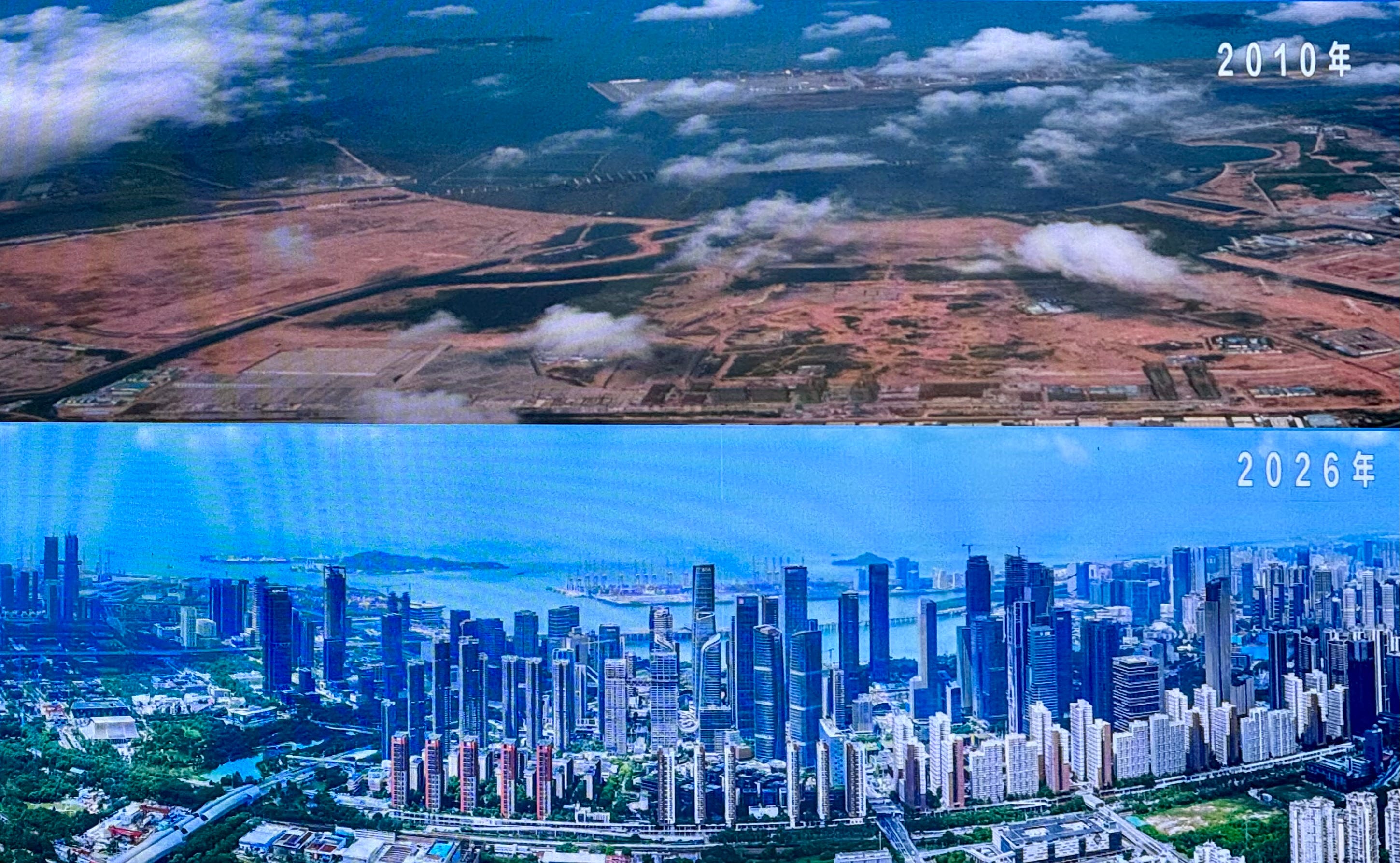
The spec is visible underground. Qianhai is the first mainland development zone built from scratch around a centralised cooling system: nine plants, 90 kilometres of underground pipes, ice thermal storage that charges at night and discharges through the day, seawater condensers feeding the loop. Every building connects to it by contract, a condition of the land transfer. From street level you see none of this, no roof-mounted chillers, no cooling towers breaking the skyline. A city built from scratch can bury its own plumbing.
The vision behind it is specific, and Xi Jinping has put his name behind it. He has inspected Qianhai repeatedly since his first visit in 2012 and has personally championed its expansion, and in 2021 the Central Committee and State Council published the Qianhai Plan, growing the zone in a single stroke from 14.92 to roughly 120 square kilometres, close to eightfold. The brief was explicit: make Qianhai the modern-services bridgehead to Hong Kong.
Beijing gave Qianhai a narrower job than another manufacturing park or tech park. Law, finance, accounting and asset management were the point: modern services run to something near Hong Kong’s standard, but on the mainland side of the border. Take the parts of Hong Kong that are hardest to copy, common law, a convertible currency, a century of professional trust, and give them somewhere to operate inside China. None of that is the sort of thing a mainland city can simply build.
So what is Beijing actually testing here? Currency, law, integration, talent: four versions of the same experiment. Can Beijing run Hong Kong’s software inside China’s hardware?
That is the bet: whether the institutional software of an open economy can be imported, run on mainland soil under a different legal system, and kept inside a zone small enough to switch off if it misbehaves. Qianhai is where China is testing whether it can have Hong Kong’s machinery without Hong Kong’s politics.
Is the Growth Real, or Just the Subsidies?
The headline growth is real, but it is no longer explosive. GDP growth has more than halved from its 2023 peak, the zone still runs on large subsidies, and no published figure separates firms that came for the institutions from firms that came for the cheque. Until that changes, the experiment is still unproven. By 2025, Qianhai reported RMB 218.2 billion of modern-services value-added, 212,000 registered enterprises and 183 Fortune 500 firms with a presence in the area. The three series that carry the story, GDP, foreign investment and trade, read better as trends than as single years, so they are charted below.
Qianhai GDP and nominal year-on-year growth, 2021–2025. The left-hand bars are shown in RMB 100 million units; the 2025 figure of 3,318.1 equals RMB 331.81 billion, about 16.6 per cent of Shenzhen's economy. The 26.4 per cent jump in 2023 came as the post-Covid rebound and the new master plan arrived together; 2026 is the first print without those tailwinds, and the first clean read on the zone's own pace.
Actual foreign investment used and its year-on-year change, 2021–2025. After the 2021–2022 peak, FDI fell almost 40 per cent in 2023 and has clawed back only part of the way since.
Qianhai trade and its year-on-year change, 2021–2025. The left-hand bars are shown in RMB 100 million units; total trade reached RMB 757.43 billion in 2025, up 7.2 per cent, after the 43 per cent surge in 2024.
The trend matters more than the level here. Qianhai's GDP grew 26.4 per cent in 2023, when the post-Covid rebound and the new master plan landed in the same year. The 10.3 per cent it printed in 2025 still beats Shenzhen as a whole, but it is well under half that 2023 pace. My read is that the cranes have done their work, and from here the institutions have to compound on their own. The largest single bet you can physically walk into is Tencent's. Penguin Island, the company's new campus, runs to 809,000 square metres of reclaimed land and about RMB 37 billion of investment, with more than 14,000 staff already on site at roughly 30 per cent complete and room for around 80,000 when it is finished. That is a company moving its centre of gravity.
Around it the institutions are accumulating: the Shenzhen-Hong Kong International Financial City now hosts around 522 financial institutions, more than 370 of them Hong Kong or foreign-funded; HSBC has put more than RMB 4 billion into its HYQ Tower, its first wholly-owned office complex in southern China; and the International Legal-services District, open since 2022, has drawn 182 legal-service entities, including seven Guangdong-Hong Kong-Macao joint-venture law firms.
The human numbers tell a narrower story. The zone’s own official boards, as presented to the delegation in May 2026, put its administered population at more than 1.3 million and the professionals it has drawn at 667,000. Against that, it has 3,316 foreign workers and 5,354 foreign residents. That is meaningful by Shenzhen standards, but tiny against Qianhai’s own scale. The zone is filling with domestic professionals much faster than it is becoming an international professional base.
The growth still runs on incentives, and they are large and getting larger: Qianhai’s 2024 measures pay qualifying foreign firms up to RMB 30 million a year, a Shenzhen-wide programme adds up to RMB 50 million, and a regional headquarters earns a one-off RMB 5 million. Competing for capital with a cheque book is fair enough, plenty of places do it. The problem is that no published figure separates the firms that came for the institutions from the firms that came for the cheque, and if the organic share were large and growing, it would be a number worth showing.
Tencent and HSBC prove that large anchors will show up. The harder test is the mid-sized foreign firm that chooses Qianhai for the institutions and nothing else: a law practice, a fund manager, an accountancy. Until that firm shows up without a subsidy attached, the case is still unproven.
Where My Money Already Sits
Here is where I have to correct a sentence I used to tell myself about this place. I used to say I had no money in Qianhai, that I only went to look. That is wrong, and walking the zone is what corrected it. I already own three pieces of how Qianhai works.
The first is Tencent. Penguin Island is the one position in this whole piece that I can physically stand inside. Tencent has genuinely planted itself in Qianhai, and that is not true of every name people attach to the zone.
The second is less obvious and matters more, because it is the plumbing. I own four Chinese state banks, which I hold as synthetic renminbi bonds rather than growth equities, a trade I set out in full in Why I Own China’s State Banks as Bonds, Not Stocks. They belong here because the cross-border renminbi rails Qianhai runs on are theirs. Bank of China is the designated offshore renminbi clearing bank in Hong Kong, and a fast-growing share of cross-border renminbi now clears through China’s own system, CIPS, which moved roughly RMB 180 trillion in 2025. Qianhai does not build its own currency plumbing. It uses theirs. I went to read this experiment directly. I own the rails underneath it.
The third is the most physical of the lot, and I only joined it up standing in the zone. I own China Merchants Port. The Qianhai bonded port zone, the logistics and free-trade spine the whole modern-services pitch is bolted onto, is planned, built and operated by China Merchants Bonded Logistics, a company it wholly owns. The reclaimed land I keep describing trades through a gateway run by a group I already hold. The ground this experiment is built on is in my portfolio, not just in my eyeline.
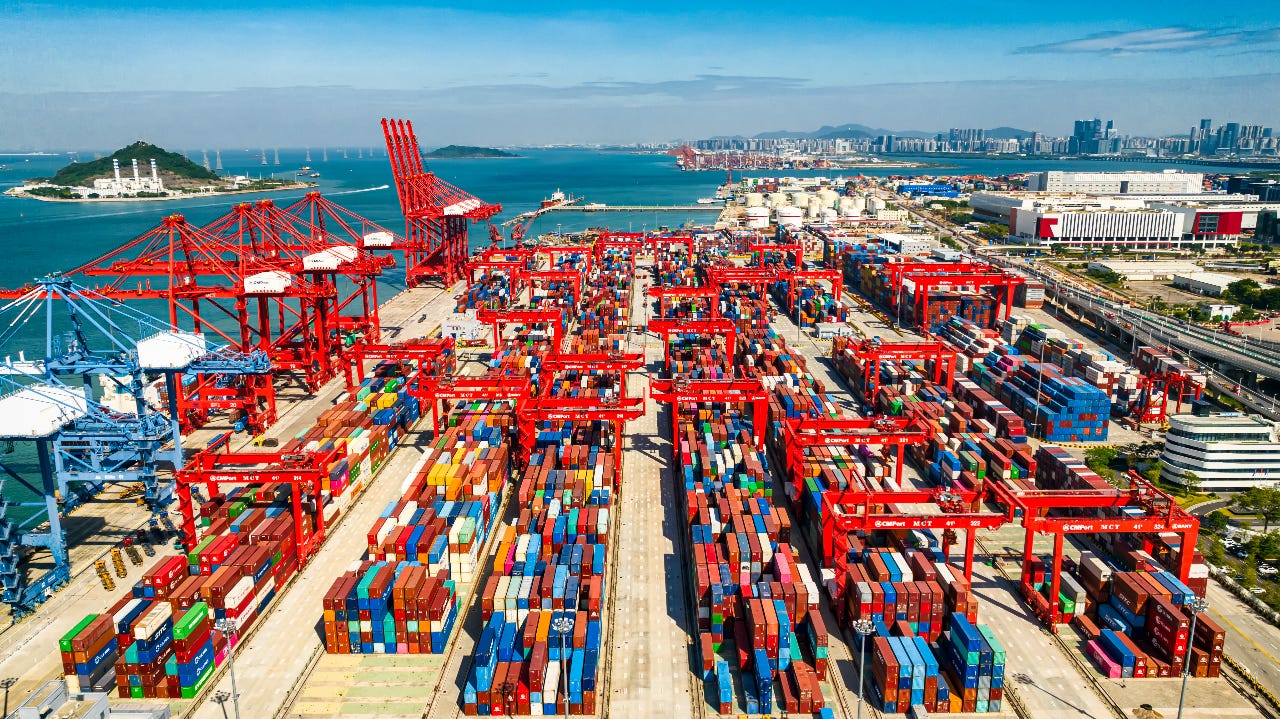
China Merchants Port’s container terminals in the West Port area of Qianhai. The bonded port zone, the free-trade spine the modern-services pitch is bolted onto, is operated by China Merchants Bonded Logistics, a wholly-owned subsidiary.
I hold no venture position inside the zone itself. The low-altitude economy I sat inside is an area I am actively exploring, written into the 15th Five-Year Plan as part of the “new productive forces” agenda, but exploring is not owning. I will not own a Chinese company unless I can see it in the Plan, and Qianhai is where the next chapters of that Plan get tested before they scale. I set the method out in full in How I Align My China Portfolio with the 15th Five-Year Plan.
So this is a held position, not a trade I am urging on anyone.
How Qianhai Plugs Into Hong Kong
The portfolio point only makes sense because Qianhai does not route around Hong Kong. It plugs into it.
Start with the renminbi. Hong Kong still sits on the world’s deepest pool of offshore renminbi, around RMB 1 trillion, and clears more than 70 per cent of global offshore renminbi payments. In June 2025 the HKMA and the PBoC launched Payment Connect, and in February 2026 the cross-border renminbi facility quota doubled to RMB 200 billion. Qianhai’s cross-border channels run on that Hong Kong infrastructure rather than competing with it.
The legal layer works the same way. The joint-venture law firms exist precisely so that Hong Kong common-law practice can reach onto the mainland. Qianhai can build the offices, the tax incentives and the cooling pipes. It cannot decree a century of legal trust into existence.
This is why I do not read Qianhai as a simple threat to Hong Kong. The obvious read is that Beijing is building a replacement. I do not think that is right. The wiring says something stranger: the copy still runs on the original’s plumbing. Firms choosing Shenzhen’s older finance district over Qianhai are choosing Shenzhen over Shenzhen. For Hong Kong to lose, firms have to choose Qianhai over Hong Kong, and that is not what the wiring is built to do.
The assumption underneath this is simple: Beijing keeps finding it cheaper to borrow Hong Kong’s convertibility and common law than to build its own. What would break that assumption is not a sudden abandonment of Hong Kong, but a quieter path where each successful pilot becomes a step towards replacing the original rather than leaning on it.
For that, I would need the renminbi fully convertible on the mainland and a mainland court trusted the way Hong Kong’s is. Neither is close. Both are earned over decades, not decreed. So I still read the rails as Hong Kong’s, and the signal I am watching is the convertibility pilots themselves.
The next Qianhai year-end enterprise data is the first real read. I will look past the headline registration count to the proxy underneath it: whether operating firms, not just subsidised registrations, are choosing Qianhai for the institutions. Get that, and the copy starts to prove itself. Without it, Qianhai stays an expensive piece of policy theatre.
As of the date of publication, I hold positions in Tencent (HKEX: 0700), China Merchants Port (HKEX: 0144), Bank of China (HKEX: 3988), China Construction Bank (HKEX: 0939), Agricultural Bank of China (HKEX: 1288) and China Merchants Bank (HKEX: 3968). Positions may change after publication without notice. Cohong Lane is a periodical publication made generally available to the public; this is disclosure of my positions, not a recommendation to buy, sell, or hold any securities. Full disclaimer · About Philip.
very interesting
Very insightful take on Qinhai it shows that China is intentional. They plan ahead and execute with the Vision in mind.