


When ServiceNow (NOW) printed Q1 2026, the number was unambiguous. Revenue acceleration. No margin collapse. No evidence that AI-native start-ups were cannibalising the installed base. The print read like the thesis I had been holding for months — and the market sold the stock off seventeen per cent on the news. Analyst downgrades printed alongside the move. The good-till-cancelled (GTC) orders I had set months earlier at the lower end of the fair-value range filled themselves into the drop. The only decision I had to make in that hour was whether to cancel the unfilled tranches. I did not.
The piece of the institutional desk that nobody can buy is not the research. It is the calm. I learned this the slow way: twenty-five years in and around institutional finance, the last six inside a family office, before leaving in 2024 to run the book alone. The question I could not yet answer was whether the discipline had become mine, or whether it still belonged to the desk. The orders that filled themselves while NOW was seventeen per cent lower on a thesis-affirming print are part of the answer. Not the buying — the not-cancelling. Passing that test once does not close the question. The next sell-off may be the one I cancel into.
I am two years in on my full-time investment journey. The research half of the desk is no longer the bottleneck. Five custom AI agents on US$32 a month of reasoning models, sitting on top of a Notion workspace that remembers everything, get me to a depth that used to require several people collecting sources, reconciling filings, and building the dossier. That does not make them a research team. It gives me research-team reach, with one human still responsible for judgement. The other half — the calm that lets the calm-weather version of me do the buying while the in-the-moment version sits on his hands — is not solved. The market is engineered to take that calm away from a retail investor, and the engineering is getting better.
The structural edge of running alone
Running a liquid book alone gives me three structural freedoms an institutional desk does not have: no benchmark to hug, no redemption risk, no career risk. Those are not minor. An institutional desk that tries to run the habits in this piece runs them into a headwind — quarterly performance windows, redemption cycles, the politics of underperforming a peer for two quarters in a row. I have none of those pressures, so the habits compound instead of fighting to survive. That is where the asymmetry comes from, and it is structural — but only when the habits are in place. Without them, the freedoms are just unsupervised drift. The family office taught me the habits. Leaving it taught me they were always the asset, not the headcount. The two scenes below show them under live fire.
Scene one: buying into the SaaSpocalypse
Through late 2025 I held the bull case on three US enterprise-software names — Salesforce (CRM), NOW, and Veeva Systems (VEEV). The market had moved to the opposite view. The narrative was the SaaSpocalypse: large language models would cannibalise the installed base, AI-native start-ups would bypass the incumbents, and the seventy-plus per cent gross margins these businesses had earned for two decades would compress as AI features became table stakes. I disagreed with the market on the business case, not on price. The agentic-workflow case for the incumbents looked stronger to me in an LLM world, not weaker. On price we agreed — these names had been too expensive for me to act on, for months. Valuation was the binding constraint.
What follows is the dossier I built to make sure I was not the one missing something. A logical bear case deserves a proper answer before you bet against it. The answer below is what got me to fair-value ranges I was willing to act on. It is not a full underwriting note for the three positions — I owe that piece separately — and the load-bearing question for this scene is not whether the dossier is right. It is whether the habits held when the print arrived.
The bear case was coherent. That was the problem. A coherent bear case on a name I want to own is the one I have to answer properly, not dismiss or minimise.
The dossier became three tests. I did not trust the bull case until it had cleared all three.
The first test was the data moat. A large language model reasons probabilistically — it works in distributions. Enterprise workflows are not probabilistic. When a customer asks for a refund, the CRM workflow has to be deterministic: same input, same output, every time. The next generation of enterprise systems is precisely that combination — agents reasoning probabilistically, calling deterministic workflows for the actions that have to be exact. CRM, NOW, and VEEV are the systems of record the agentic stack has to call into, and they own the deterministic workflows around that record. Ten years of sales history, customer relationship maps, service interaction logs — context no foundation model can replicate from general training. That is what the sell-off had missed.
Then came the enterprise plumbing: security and complexity at scale. Inside a large enterprise in 2026, point solutions proliferate — one agent for HR queries, another for IT helpdesk, another for sales outreach. Within a year there are fifty independent AI systems from fifty different start-ups running against core data. Every one is a potential prompt-injection vector. Every one requires IT approval, security certification, user retraining, and the political buy-in of the SVP whose department it touches. The CTO ends up insisting on a single system of coordination: a pre-approved, enterprise-grade, security-audited platform the team already knows, one that connects to the systems of record they already run. That is ServiceNow’s AI Control Tower. That is Salesforce’s Agentforce. The bear narrative systematically ignores this constraint because it is modelled by people who have never sat in an IT governance meeting or only care about next quarter’s numbers.
The last test was where the asymmetry actually lived. Today, CRM and NOW compete for IT and software budgets — measured in tens of billions. If AI agents automate work previously done by people — inside sales, tier-one IT support, compliance workflows — the relevant budget shifts. It is no longer the software line item. It is the labour line item. Corporate headcount budgets are measured in trillions. An enterprise deploying agents at multiples of the output-per-dollar of a human employee is not buying software any more. It is replacing payroll. The platform does not automatically take that budget. The incumbents that climb from systems of record into the system of action — the layer that executes tasks rather than stores data — become the toll roads across that flow. Once a customer is hooked on agents that work, the switching cost is the institutional memory embedded in the data model, not the software contract. Existing-book gross margins may still compress as agentic pricing pressure works through. The labour-budget asymmetry is what makes the platform worth owning anyway.
Then the market obliged.
That was the dossier I had on the desk by late 2025. Fair-value ranges, on my numbers, well below market price for months. Sizing decided in calm weather. Then the SaaSpocalypse arrived: a multi-month software capitulation, deepened by Middle East war pressure on risk assets. CRM and VEEV filled close to the peak of the bearish sentiment — bought, in the moment everyone else was selling, by orders the calm-weather version of me had set months earlier. The starter tranches in NOW filled in the same window. That part was uneventful — calm-weather work doing what it is supposed to do.
The eventful part was NOW. The Q1 2026 print landed inside the SaaSpocalypse, not after it. Revenue accelerated. The CFO commentary described exactly the agentic-workflow adoption I had spent six months underwriting. Guidance for the remainder of the year flagged slightly lower margins on the cost of integrating recent acquisitions — acquisitions that, on my reading, strengthened the data moat the case rests on. The market read it as margin pressure. The moat point was ignored. The stock dropped seventeen per cent. Analyst downgrades followed. The GTC orders I had set in calm weather, sitting in tranches at the lower end of my fair-value range, started filling against a tape that was telling me I was wrong.
I did not sit through those hours calmly. A tight pull behind the sternum. The urge to cancel before they embarrassed me further. A low, hot kind of regret — the suspicion that someone else was seeing something I had missed, and the orders were going to keep filling all the way down to a number that would look very stupid in a month.
I named what I was feeling. Then I did the cognitive move the Budapest test had taught me a year earlier: separate the feeling from the state of the business. The print was the business. The price was the print being processed by a market that had decided in advance what the print was going to say. The dossier had not changed. Three questions. Had the data-moat case weakened on this print? No — the CFO commentary and the acquisitions had strengthened it. Had the security-and-complexity case shifted? No. Had the labour-budget asymmetry moved? No. The price had moved. Nothing else had.
I did not cancel the orders. The remaining tranches filled over the next two days. The position is currently above my entry; that is not the point. The point is the decision-shape, which has to be the same whether the stock immediately rewards it or sits underwater for two quarters. I do not know which it will do next, and writing this piece is not predicated on the answer.
What this scene shows is the four habits running into a moment that tests them. Investment policy: the fair-value range was set in calm weather, in writing, weeks before the print. Primary-source research: the bear case got a proper answer, not a dismissal. Calm-weather decision-making: the rule was if a thesis-affirming print arrives and the market sells, let the orders fill inside the range. Execution discipline: the tranches sat in the book and filled themselves while the screen was red. None of this was AI-enabled in the moment. The AI desk wrote the policy. The policy set the orders. The orders built the position. What the moment required of me was not action. It was the discipline not to cancel.
That is the harder of the two registers. The next one is easier — and shows what the system does when I can mostly stay out of its way.
Scene two: scaling China Everbright Water through the 14-to-15 Five-Year Plan bridge
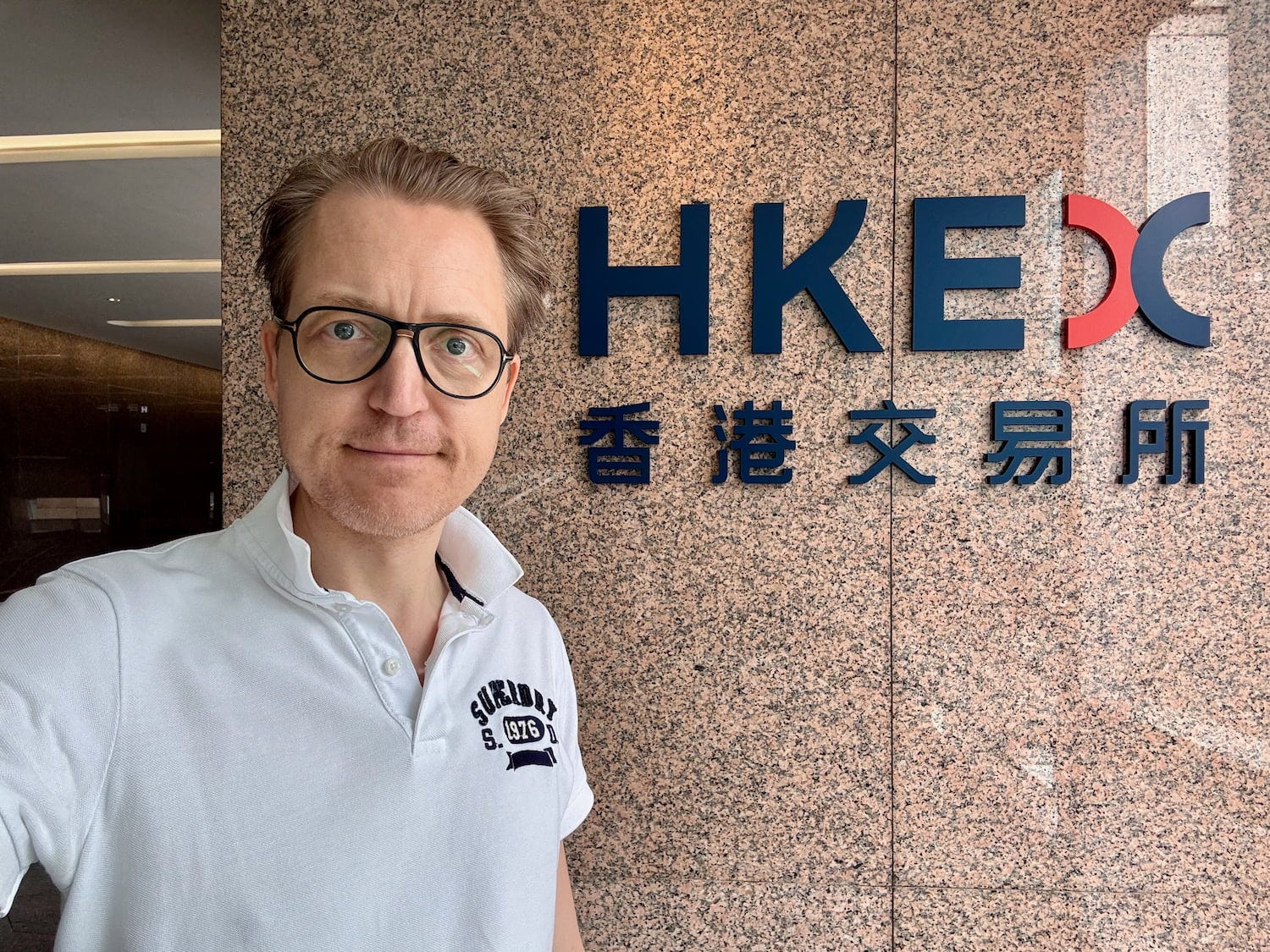
Late 2025. China’s Fourth Plenum hits the wires in the early afternoon, Hong Kong time, on a desk twenty minutes from HKEX. Within the hour the outline of the 15th Five-Year Plan — the country’s economic priorities for the next half-decade — is on my desk. Beautiful China. Water governance named a structural priority. Priority regions made explicit. I am already long China Everbright Water (CEW), a position I initiated in September on work my AI desk ran through August. The Plenum did not trigger the trade. It extended the visibility of the policy the trade was already inside — same direction, longer clock, regions named. That earned the scaling decision.
The interesting moment in this scene is not the Plenum. It is September — buying the position with nothing external yet rewarding me for it.
Under the still-running 14th Five-Year Plan, the research desk worked open-ended. I do not read Chinese well enough to underwrite a policy thesis unaided. The workflow had to be built around that fact. Build a longlist of regulated water-treatment operators that fit the income book. Map the transmission chain from policy mandate to operator cashflow. Work that used to take a team a month. I did it in hours. That speed mattered: it freed August for the policy-to-cashflow work itself, not the data collection. When CEW emerged at the top of the longlist, the agent’s instructions changed: filings only, Plan clauses returned with Chinese alongside English, missing data flagged rather than guessed. The workflow is deliberately suspicious — clause references preserved, any gap treated as a gap rather than filled with fluent nonsense. Conviction does not survive a summary. It survives a source — and on a Chinese-policy thread the source is in Chinese.
By September the numbers were clear. Fair-value range, size band, starter conditions written into the policy in August, while the thesis was still cooling. Looking at the quote screen in September, the in-the-moment version of me wanted to wait. CEW is a smaller operator in a sector I know less well than Chinese banks or insurers; the instinct was to size conservatively and watch another month. Nothing on the tape rewarded the decision — no catalyst, no upgrade, no peer move. Waiting another month felt like the disciplined thing. The August version of me had already overridden that. I bought. Calm-weather decision-making is not the absence of doubt. It is a policy with the authority to override doubt — written when the doubt was not in the room.
When the Plenum outline landed, the same deterministic pipeline ran against the new text. Mandate confirmed and extended; priority regions named; cashflow profile re-tested. The rule fired: if visibility extends, scale to the upper band. I had already decided in August. I executed. By the time the National People’s Congress formally approves the Plan in March 2026, the position has been at its new size for nearly five months. The news prints. I do nothing. Execution discipline, in this case, is the absence of action.
Scene one was holding my nerve while the screen ran red. This was overriding quiet doubt while the screen showed nothing. Same discipline. Different kind of discomfort. The AI gave me depth: policy reading, primary-source checks, and enough Chinese to stop pretending I could underwrite the thesis unaided. The decisions were still mine, twice, and both were made before the screen gave me anything back.
How the desk actually runs
Two reasoning environments. US$32 a month. The tools are not what matters; the architecture is. The architecture turns on one distinction: probabilistic versus deterministic mode. Probabilistic mode is hypothesis work — building the regulated water-treatment operators longlist from a sector universe, ranking by fit to the income book, mapping how a policy mandate plausibly transmits to operator cashflow. The model reasons across distributions; the answer is honestly uncertain and meant to be.
Deterministic mode is the opposite. When CEW emerged at the top of the longlist, the agent’s instructions changed — filings only, Plan clauses with Chinese alongside English, missing data flagged rather than guessed. No improvisation. No fluent inference papering over an absent source. The same model on the wrong mode on the wrong task is worse than useless: it sounds confident about the thing you most need it to admit it does not know.
The full architecture — five agents, the Notion memory layer, how the mode distinction is enforced in practice — is a future piece. What matters here is that the US$32 buys the discipline of mode, not the discipline of the operator.
What the two scenes earned
What the two scenes earned, between them, is the documented version of the four habits twenty-five years in markets installed in me — six of them inside a family office: write the policy in calm weather; read primary sources, not paraphrases; make the hard call when nothing is rewarding it; set the trade up before the moment arrives. The market is engineered against all four — which is why the moment is the wrong place to make them.
The half the US$32 does not buy
The architecture is cheap, deliberately so. When the tool is expensive, I justify using it whether or not it is working. The discipline that decides when to use it is the part that took twenty-five years to build.
What I left the family office with was not a system. It was the knowledge of what good looked like — and a trained instinct for the difference between a market that is genuinely wrong and a portfolio that is genuinely broken. The AI stack is what let me rebuild the depth without rebuilding the headcount.
No Pain to Begin With sets out the structure. Volatility Is the Admission Price sets out the psychology. This is the operating layer that sits beneath both.
But the more I run this desk, the clearer it becomes that the binding constraint is not analytical depth. It never was. The binding constraint is what I described sitting in Budapest a year ago — the gap between what I felt and what I knew, and the willingness to act on the latter while the former was still screaming. That gap is not closed by better models. It is closed, slowly and unevenly, by accumulating enough experience that the subconscious mind starts to recognise the pattern rather than flinch at it.
The test is whether the calm-weather version of me is still in the room when the moment arrives — and whether I can tell, in that moment, the difference between a price moving and a business changing.
The US$32 builds the first. The second is built more slowly, on real tests like the one I described at the top of this piece.
The discipline was always there. The question was always whether I could run it alone. The answer, so far, is yes — but the words so far are doing real work in that sentence.
As of the date of publication, I hold positions in China Everbright Water (HKEX: 1857), ServiceNow (NYSE: NOW), Salesforce (NYSE: CRM), and Veeva Systems (NYSE: VEEV). Positions may change after publication without notice. Cohong Lane is a periodical publication made generally available to the public; this is disclosure of my positions, not a recommendation to buy, sell, or hold any securities. Full disclaimer · About Philip.
Great piece. AI can scale research, but not temperament. The real edge is sticking to calm‑weather rules when the tape turns red. Do you think discipline can ever be fully systematized?