


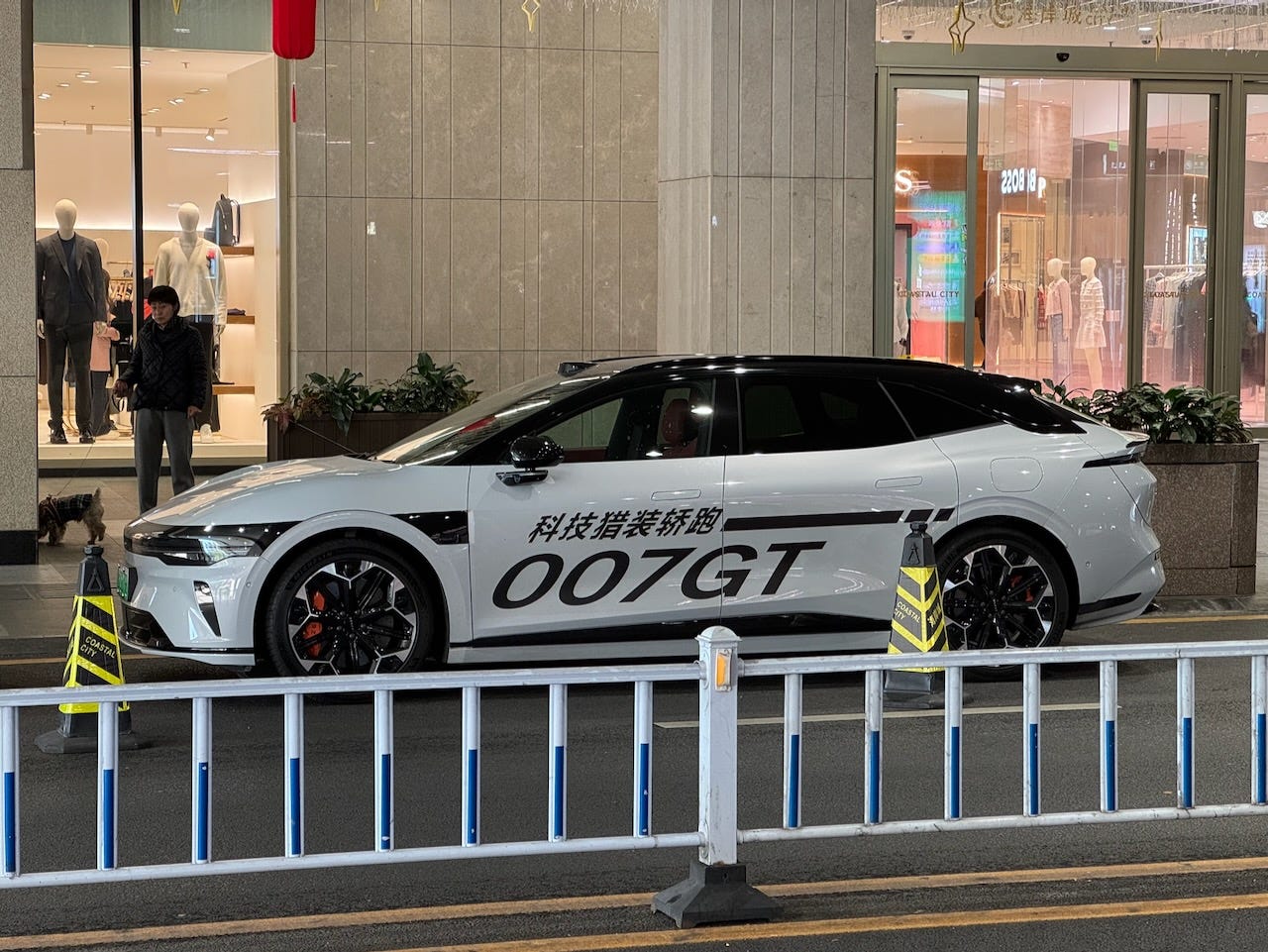
Walking home from dinner in Shenzhen earlier this week, I stopped in front of a Zeekr 007GT parked at the kerb outside Coastal City. White, with “007GT” painted down the door in letters you could read from across the road. It is the sort of car Chinese manufacturers spent a decade being told they could not build, now sold under a brand designed to travel. Standing there, I felt the specific unease of someone who owns the company and cannot tell whether the volume is profit, or just the same car travelling farther without earning any more for it.
So I opened Zeekr’s European configurator on my phone. The same shooting brake, sold as the 7GT in Europe, starts at about €44,000, against a little under RMB 200,000 here: roughly double once converted. VAT, tariffs, freight, richer specification and dealer margin all sit inside that gap before any of it reaches Zeekr. The number my position turns on was parked in front of me and still unverifiable in either direction.
I own BYD and Geely in my growth sleeve, Geely the larger of the two. Together they are about 3.4 per cent of the sleeve, roughly 2.2 per cent Geely and 1.2 per cent BYD. I bought BYD on the possibility that Chinese scale could become a globally durable, locally profitable business: the electric Toyota thesis. Geely now has to meet the same standard.
H1 2026 confirmed that both companies are exporting their way out of a weaker domestic market. It did not confirm that the economics have followed them abroad. Foreign profitability is the first hard test.
Relocated volume, unproven economics
BYD sold 1,808,511 new-energy vehicles in H1 2026 (NEV: battery-electric plus plug-in hybrid), down 15.72 per cent. Overseas NEV sales rose 70.65 per cent to 792,256, now 43.81 per cent of the total, while domestic volume fell 39.57 per cent. BYD is not simply shrinking. It is relocating its demand.
Geely sold 1,422,958 vehicles, barely up on the year, with domestic volume down about 22.6 per cent and exports carrying the difference. Its total passenger-vehicle exports were about 474,228, but the figure comparable with BYD is NEV-only exports of 275,417. I use 275,417. The larger number makes Geely’s electric export position look stronger than it is, which is exactly the flattering error I am trying not to underwrite.
The domestic fall is not a clean read on competitive failure. China’s NEV purchase-tax break was halved from the start of 2026, pulling demand into late 2025, while the national trade-in scheme was renewed rather than withdrawn. BYD management has also pointed to a second-generation Blade Battery production-line transition as a bottleneck. But a 39.57 per cent drop is too large to file under calendar effects, and a production bottleneck is a problem to fix, not a permanent excuse. The home market is genuinely harder. Exports are now doing the work domestic demand used to do.
A visible price gap, an unreported margin
Geely’s export mix climbed from 13 to 29 per cent as group gross margin rose to 17.5 per cent, with revenue up 15 per cent on 1 per cent more volume. BYD’s December 2025 European pricing ran roughly twice its Chinese level, about US$45,083 against US$23,929. Both companies have the vertical integration, product range and distribution spend to make a higher foreign realisation plausible.
A European sticker price does not tell me what tariffs, freight, certification, richer specification, VAT and dealer economics leave for shareholders. Neither company reports an overseas auto gross margin. The strongest number I have, a Dolphin analyst estimate relayed via Longbridge in April 2026, put Geely's export margins about ten points above domestic. It is not a filing.
The BYD thesis set a higher bar than a foreign margin premium. Local durability requires factories, suppliers, after-sales capability and enough political staying power to earn through a cycle. Hungary will be the first serious test, and it is already behind schedule: series production has slipped from an original Q2 2026 target to Q4, per Reuters, citing BYD EVP Stella Li.
I set my expectation for Hungary on BYD’s original guidance without discounting it for the thing industrial builds in new countries tend to do, which is run late. That is on me. It is the same discount I owe Geely’s export-margin estimate before I let myself believe it.
A disclosed overseas margin above the domestic business would be encouraging, but locally produced cars still have to earn through European labour, logistics and tariff costs. That is where the Toyota comparison becomes useful rather than flattering. Toyota’s durability came from learning to build, source and sell locally in the markets where it wanted to last.
Why this is a portfolio problem, not an industry one
Everyone already knows Chinese competition is rising. The sharper point is that I own both sides of the same unreported claim. If overseas margins compress, I do not hold two diversified outcomes. I have made the same mistake twice through two companies.
The visible evidence is becoming less comforting. On China Passenger Car Association (CPCA) figures, BYD took 34.5 per cent of China's national NEV exports in H1 2026; Chery, Geely and Tesla's China operation added another 35.6 per cent between them. Geely's own NEV exports rose 601.4 per cent off a small base. This is not two companies expanding into empty markets; it is a domestic price war acquiring passports. A premium is harder to defend when everyone crowds the same foreign forecourts.
Trade policy can take the margin from the other side. The European regime remains unsettled, whether it lands on countervailing duties or a negotiated minimum price, and any thesis built on today’s price gap has to survive it. Volkswagen’s response shows how real that pressure is: in July it confirmed cutting its model line-up by up to half and vehicle options by up to three-quarters, explicitly to compete with Chinese carmakers, while lobbying for tougher tariffs. It is cutting costs and demanding protection because it has decided to survive. That fight is the other side of the margin gap I am underwriting.
Even the volume may be running ahead of real demand. The IEA found 2025 Chinese EV exports ran more than 25 per cent ahead of overseas retail sales. Some of those cars are sitting in channels, not driveways, and there is no H1 2026 clearance data yet to show that the gap has closed.
The two roads, kept small
BYD and Geely are not running the same playbook. Geely is using the overseas footholds of Zeekr and Lynk & Co rather than starting with a single-brand network. BYD is pairing its own dealer network with local production, already running in Thailand and Brazil and now reaching Europe with Hungary.
Geely’s route is cheaper in capital. BYD’s is more capital-intensive, and if its factories and suppliers eventually earn through a cycle, the advantage is harder to replicate. I cannot yet show which route produces better economics, so I treat the difference as a question inside the position rather than a separate bet.
What would change my mind
I hold three outcomes, weighted.
Export margin holds, 30 per cent. Segment disclosure confirms real foreign gross profit; localisation deepens and the premium survives.
Volume rises, margin compresses, 55 per cent. My modal case. Chinese capacity follows demand abroad, trade friction takes a slice of the price gap, and neither company discloses the margin needed to prove the premium survives. Geely may still reach foreign volume with less capital; BYD may earn more if control of production and distribution outweighs tariff and localisation costs. I cannot yet show which.
Domestic weakness overwhelms the offset, 15 per cent. The home decline outruns exports even after the tax pull-forward fades.
These weights record what would move me. They are not a precise forecast.
August is the first test, not the verdict
Management has indicated that overseas profitability is structurally stronger, but I cannot verify its magnitude or durability from segment disclosure.
The next real evidence arrives with the interim results, expected in late August. I want an overseas segment breakout from BYD or export profitability disclosure from Geely. Neither has committed to provide one. If both stay silent, I will not read that as evidence of weak economics. I will keep the positions capped because I do not add to an unproven leg.
My failure condition is not one low overseas margin. It is both companies shipping more cars and committing more capital abroad while becoming less able to earn through the markets they are trying to own. A margin below the domestic business, or overseas prices falling materially as volume climbs, would be part of that evidence. I would rather hold a position with one honestly unproven leg than sell on a headline I already know is the wrong scoreboard.
I own BYD and Geely for the Toyota thesis: that a Chinese carmaker can become a durable global business rather than a temporary exporter of surplus volume. The reported margin is the first instrument for testing whether foreign volume is earning its way towards that business.
If it is not, I will be holding two positions that grew for the same wrong reason. That is the cost of having made the same bet twice.
As of the date of publication, I hold positions in BYD Company (HKEX: 1211) and Geely Automobile Holdings (HKEX: 0175). Positions may change after publication without notice. Cohong Lane is a periodical publication made generally available to the public; this is disclosure of my positions, not a recommendation to buy, sell, or hold any securities. Full disclaimer · About Philip.
Great article and I agree with the thesis that BYD or Geely will rival Toyota as largest car producer globally