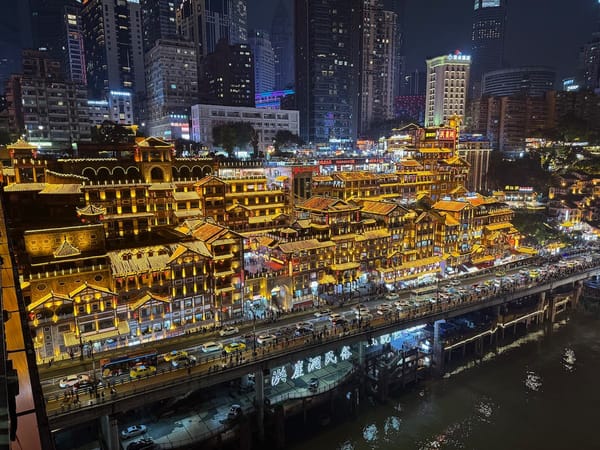
Most investors in China — whether they hold individual stocks or broad ETFs — have exposure to Chongqing. They just do not know it. BYD manufactures Blade Batteries here. CATL runs its first "factory-in-factory" production line here. China Mobile operates one of its eight national data centre hub nodes here. I hold all three, and until recently, I could not have told you why any of them chose this particular city.
In a car from Chongqing East station to the hotel, I spotted a vehicle I had never seen before. Low, sculpted, with lines that belonged in a concept video rather than on a road. The badge read AVATR — a joint venture between Changan Automobile — Chongqing's anchor state-owned automaker — CATL, and Huawei. Three of China's most consequential industrial players, converging in a single vehicle, designed and assembled in a city roughly 2,000 kilometres from the nearest major seaport — and from anyone's radar.
That is, broadly speaking, the kind of detail that makes me get on a train. Not because one car badge is a thesis — it is not — but because it raised a question I could not answer from Hong Kong: why here? Why are BYD, CATL, and China Mobile all building significant operations in an inland city that most investors cannot place on a map? The mountain topography over the Yangtze is genuinely dramatic, but I did not come for the scenery. I suspected my portfolio had more Chongqing in it than I understood, and I wanted to know whether that was a good thing or a problem.
What Role Does Chongqing Play in China's Economic Plan?
Chongqing is one of only four direct-administered municipalities (直辖市) in China — alongside Beijing, Shanghai, and Tianjin. That status means it retains a larger share of tax revenues, issues its own municipal bonds, and competes directly for central government capital without provincial intermediation. When Beijing allocates 800 billion yuan (~US$110 billion) in ultra-long special treasury bonds for infrastructure in 2026, Chongqing sits at the same table as Shanghai.
"Boost the development capacity of the Chengdu-Chongqing economic zone." — 15th Five-Year Plan Recommendations, Section 29 (October 2025)
The city anchors the Chengdu-Chongqing Economic Circle, which generated RMB 8.72 trillion (~US$1.2 trillion) in GDP in 2024 — roughly 6.5% of China's national total. But the GDP number is not what caught my attention. What caught my attention was the policy stack underneath it: direct municipality status, the Liangjiang New Area (China's first inland national-level development zone, restructured under a single administrative entity in January 2026), a Pilot Free Trade Zone handling roughly 70% of the municipality's foreign trade across just 0.1% of its land, and the China-Singapore Demonstration Initiative — a government-to-government project giving Chongqing privileged access to Singapore's capital networks and ASEAN markets.
Many Chinese city investment promotion brochures claim to be "nationally strategic." What makes Chongqing different is not any single designation — it is that no peer inland city has this many stacked in one place. Not Chengdu, not Wuhan, not Xi'an. The question I needed to answer on the ground was whether that stack translates into anything an investor can actually touch, or whether it is just another brochure.
How Big Is Chongqing's Economy?
Chongqing's 2024 GDP reached RMB 3.219 trillion (~US$440 billion) — China's fourth-largest city economy, ahead of Guangzhou since 2022. Growth of 5.7% beat the national average by 0.7 percentage points — consistent outperformance in four of the last five years.
Ask a fund manager in London or New York to name China's fourth-largest city. I have tried. They cannot.
But the headline GDP is not the story. The composition is.
In 2024, Chongqing produced 953,200 new energy vehicles — a 90.5% year-on-year increase, compared to a national NEV growth rate of 34.4%. The automotive industry alone contributed two-thirds of Chongqing's entire industrial expansion. Two-thirds. From one sector. This is a city that was the world's largest motorcycle manufacturing base, then became China's top conventional auto hub at 3.15 million vehicles in 2016, then watched output collapse to 1.72 million by 2018 as the market shifted under it. What followed was a five-year pivot from combustion to NEVs — roughly 43,000 units in 2020 to 1.296 million in 2025, reclaiming the number-one auto-producing city title.
That is a remarkable industrial transformation. It is also a remarkable concentration of risk — and I will come back to it.
One more number: Chongqing’s population is in natural decline — a net loss of 92,000 people in 2024. Yet the economy grew 5.7%. If your China model starts with demographics, Chongqing is the city that breaks it. The growth is coming from productivity and capital upgrading, not headcount. For an investor, the calibration tool here is income growth — per capita disposable income rose 5.6% — not population trajectory.
What Makes Chongqing's Infrastructure Hard to Replicate?
Here is the detail that made me sit up.
While I was in Chongqing last November, I read in the local press that China had just launched its second fixed-schedule freight rail service to Europe — from Chongqing to Budapest, carrying automotive parts and electronics. The first route, to Duisburg in Germany's Rhine-Ruhr heartland, has been running since 2011 and became China's first fully fixed bilateral timetable service in June 2024. Transit time: roughly 13 days — half the sea freight time via Shanghai.
Why does this matter? Because BYD is building a €4 billion plant in Szeged, Hungary. CATL is constructing a 40 GWh gigafactory in Debrecen. Budapest is 250 kilometres from Debrecen and 160 from Szeged. When Chongqing's 1,000-plus automotive parts suppliers need to ship components to those European assembly lines, the timetable now exists. Eleven days by rail versus thirty-plus by sea makes rail competitive for just-in-time supply chains — and for the first time, an inland Chinese city has a direct logistics link to the Central European EV cluster that did not exist two years ago.
The rail routes are only one axis. Guoyuan Port — the largest on the upper Yangtze — moves goods east to Shanghai. The New International Land-Sea Trade Corridor connects south to ASEAN, cutting Singapore transit from 20 to 10 days. Jiangbei Airport crossed 50 million passengers and 500,000 tonnes of cargo in 2025. Chongqing is the only city in China to hold all five categories of national logistics hub designation simultaneously — port, land-port, airport, production-service, and trade-service.
The question for any manufacturer is no longer whether Chongqing can move goods. It is whether lower land costs, lower wages, and direct policy subsidies — plus competitive logistics — make the inland option superior to the congested, expensive coast. For a growing number of sectors, the maths now favour Chongqing.
Ground Truth — What You Won't Read Elsewhere
To understand Chongqing, you have to leave it. The data told me what the city produces — but not what it looks like when production stops and the mountains start.
One morning we drove ninety minutes southwest to the Dazu Rock Carvings. The carvings are extraordinary — a UNESCO site, 50,000 sculptures carved into cliff faces since the 7th century. But it was the drive that changed how I think about the data.
Within forty minutes of leaving the urban core you are in a different economy. The road narrows. The buildings are older, lower, unfinished. This is the other Chongqing: 82,400 square kilometres of mountain terrain where the main urban district produces 78% of GDP. The per capita income gap between urban residents (RMB 49,778, ~US$6,800) and rural residents (RMB 22,221, ~US$3,000) is more than two-to-one. An investor targeting Liangjiang New Area is accessing a materially wealthier market than the headline suggests. An investor assuming the headline applies evenly is making an error I nearly made myself.
Back in the city, the street-level economy felt alive. Restaurants were packed — not the performative busy of a new development, but the organic busy of a consumer economy actually spending. Wholesale and retail grew 9.5% in 2024. Accommodation and catering grew 7.3%. You feel these numbers in the queue for a hotpot table at 9pm on a Tuesday, not in a spreadsheet. (If you visit: skip the tourist hotpot and try 烤匠麻辣烤鱼. It is a Chengdu-born chain — and their sea bass, buried under a small mountain of dried chillies and green Sichuan peppercorns, is the best thing I ate in China in 2025. 不吃火锅,就吃烤匠.)

One evening walking through Chongqing's malls is not statistically significant. I know that. But what on-the-ground observation gives you is not data — it is a filter for obvious nonsense in the data. When a bearish report claims Chinese consumers have stopped spending, I can check that against what I saw on a November evening. It does not prove the report wrong. But it tells me to ask better questions about which consumers, where. That is worth the trip.
What Does This Mean for My Portfolio?
I came to Chongqing to understand a city. I left understanding three of my positions better.
BYD operates a dedicated Blade Battery factory here through its Fudi subsidiary: 8 production lines, 20 GWh annual capacity, running at or near full utilisation since 2020. I knew the factory existed. What I had not connected was the logistics. Chongqing's fixed-schedule rail to Duisburg and Budapest means BYD can ship battery components to its European plants faster — and likely cheaper — than from any coastal Chinese city. For a vertically integrated company pouring €4 billion into a Hungarian factory, having a battery production base connected by timetabled rail to Central Europe is a structural cost advantage that was not in my model. It is now. My confidence in the European expansion thesis went up.
CATL entered Chongqing in June 2025 with something I had not seen before: a "factory-in-factory" model — two battery pack lines physically inside the SERES Super Factory in Liangjiang, a five-year exclusivity agreement for all AITO vehicles to use CATL Qilin batteries, planned annual output value of RMB 7 billion (~US$960 million). This is not a supply contract. This is CATL embedding itself into a customer's production floor, making the switching costs enormous. The same rail infrastructure connects CATL's Chongqing output to European markets. Two battery giants, same city, same logistics advantage.
China Mobile runs a campus data centre here that is one of eight national "Eastern Data, Western Computing" hub nodes — 6,600-plus racks, at least 128 petaflops. Chongqing's lower land and energy costs make it a natural location for compute-intensive workloads, and the 15th Five-Year Plan's AI manufacturing mandate will drive demand for exactly this kind of infrastructure. This is not a branch office. It is a strategic node in the national policy architecture I wrote about in my last piece.
These companies did not end up in Chongqing by accident. The policy stack, the cost structure, the logistics — they make it a rational choice. Understanding why they are here makes me more confident holding them.
The Thing I Cannot Figure Out
Two-thirds of Chongqing's industrial growth in 2024 came from one sector: automotive. NEV output grew 90.5% that year — but by 2025, the growth rate had already halved to 36%. Nationally, NEV growth is decelerating too. I expect Chongqing will converge toward the national rate within two to three years.
Replacement sectors are named — electronics, advanced materials, AI, biomedicine — but they are early. If automotive growth decelerates to 10–15% before those sectors reach scale, Chongqing faces a growth gap. Not a crisis — but a repricing event for any company whose Chongqing operations are primarily tied to the NEV supply chain. For BYD and CATL, that concentration is the risk I am now watching.
The signal I will use to test the infrastructure thesis: the Budapest rail route frequency. It currently runs biweekly. If it goes weekly by end-2026, the cargo demand from BYD's Szeged plant and CATL's Debrecen gigafactory has confirmed the commercial case. If it stays biweekly for twelve months, the route is a political achievement, not a logistics solution — and part of my conviction weakens.
I hold my positions. I watch the signals. The rest, I do not know yet.
💡
As of the date of publication, I hold positions in BYD (1211.HK), CATL (3750.HK), and China Mobile (0941.HK). Positions may change after publication without notice. This is disclosure, not a recommendation. Full disclaimer.