Cohong Lane is research for intellectually honest investors who care about China — from individual investors to institutional allocators. I publish the work behind my own portfolio decisions: policy-to-cashflow analysis, valuation work, and on-the-ground checks that help separate narrative from reality.
Born in Denmark with German roots, I placed my first trade in 1999 with a $1,500 paycheck. Twenty-five years and one career later — technology strategy, financial consulting across EMEA and APAC, a first stint in Hong Kong from 2011 to 2016, and finally CFO for a global family office in Copenhagen from 2018 to 2024 — I relocated back to Hong Kong in 2025 to invest my own savings full-time.
That sounds like a “quit my job to follow my passion” story. It isn’t. It is a capital allocation decision.
Over the course of my career I watched how institutional allocators actually process information and manage risk. Not the clean version from textbooks. The real version: messy, probabilistic, full of judgement calls made with incomplete data. The best allocators I worked with shared one trait — they were honest about what they didn’t know before anyone else in the room was willing to admit it.
That same honesty is what pulled me toward the biggest gap I kept seeing in markets: the distance between the China being described and the China operating in front of you.
Two things became clear. First, the gap between what Western mainstream media reports about China and what is actually happening on the ground can, at times, be wide enough to be investable. Second, the only way to close that gap is to be here.
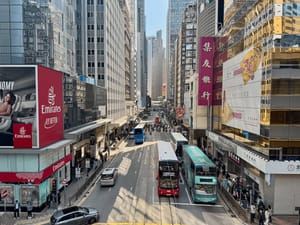
Being physically in Hong Kong, at the intersection of international capital markets and mainland China's Greater Bay Area, helps — but not in the way people assume. Walking through a BYD dealership in Shenzhen doesn't give me statistically significant data. It gives me calibration. And when Beijing sets binding targets for factory automation or EV adoption, that policy commitment creates demand visibility that market-driven economies simply can't match — a feature, not a bug, for anyone willing to trace the mechanics. When I read that Chinese consumers have “stopped spending,” I can check that against what I see in Shenzhen malls on a Saturday. It’s not proof. It’s a filter for obvious nonsense — and in China coverage, there is a lot of obvious nonsense to filter.
I should also be upfront about how I think, because it shapes everything I write. I don’t predict. I think in distributions — ranges of outcomes — and ask whether the current price compensates for the uncertainty. I can have a view, and I do, but I try to hold it probabilistically rather than with the false confidence that makes for better headlines. When I’m wrong, I want to understand why the range shifted, not pretend I never held the position.
My research focuses on three areas. First, China mechanics — tracing policy mandates and money flows to turn Five-Year Plan targets into investable themes, verified on the ground through factory visits, dealership checks, and city walks across China's interesting cities. Second, portfolio and process — detailing how I structure and run my own portfolio, with real decisions and real money. Third, the independent life — the operational reality and psychology of investing your own savings without a salary in China.
Western mainstream media tends to default to “China is in structural decline.” Local media defaults to “China’s rise is inevitable.” Both are narratives dressed up as analysis. I’d rather look at the actual numbers — earnings, policy documents, capital flows — and trace the mechanics underneath the headlines.
A few things I won’t do: I won’t give you stock tips. I won’t chase the news cycle — I publish when I have a view, not because something happened. I won’t dumb China down to a single story, bullish or bearish. And I won’t pretend to have certainty I don’t possess.
My portfolio is structured around two core buckets — Income and Growth — with a small, emerging allocation to asymmetric Venture bets. The design principle is simple: if my income stream covers baseline expenses, I never become a forced seller. Every other decision becomes optional.
You can expect 1–2 dispatches per week. It is the research I’d want if I were allocating someone else’s money — except it’s mine.